Mammoth Hunt
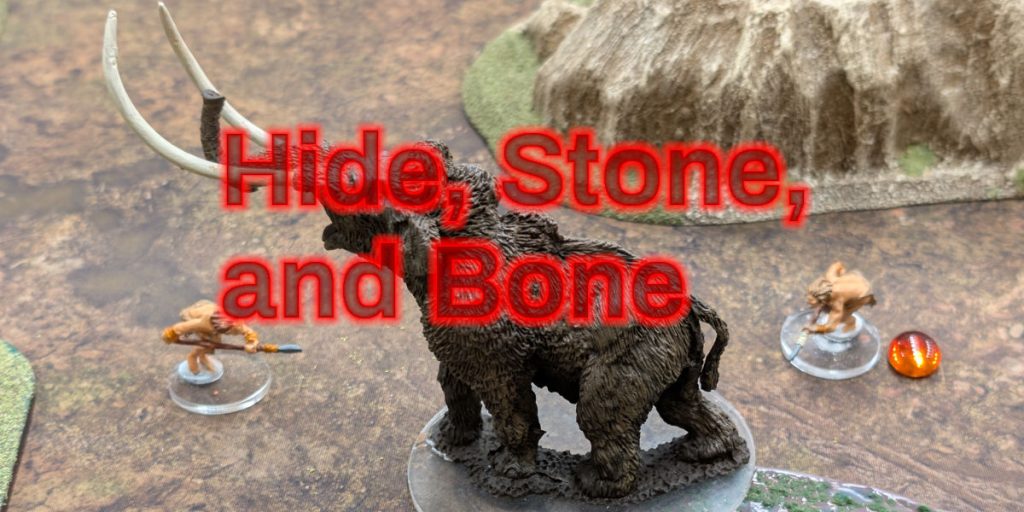
Our wargame this week was something somewhat different. After our trip to Spanish caves, we got the need to have a game of neolithic adventure. I’d looked at two sets of rules. The first was Tooth and Claw, the second Hide, Stone, and Bone.
Tooth and Claw seems more focused on modern characters hunting wild animals, possibly in a Lost World sort of way. The neolithic hunters side of things is added on the side, and isn’t a focus of the rules. The rules also seemed quite complicated, and I was looking for something simpler.
Hide, Stone, and Bone describes itself as a Paleolithic Skirmish Wargame. The focus is very much playing Homonids (either Homo Sapiens or Neanderthals) surviving in pre-history. The bulk of the rules are actually for campaign play. You have a tribe (or multiple tribes), trying to survive. You need to hunt, make clothing and create babies for your tribe to survive from one year to the next. The ‘skirmish wargame’ side of it is for the Big Day events that happen.
So we selected Hide, Stone, and Bone as the game to focus on. For our first try at the game, we focused just on some Big Day events, and ignored the tribe building aspects of the game.
Lions and Neanderthals
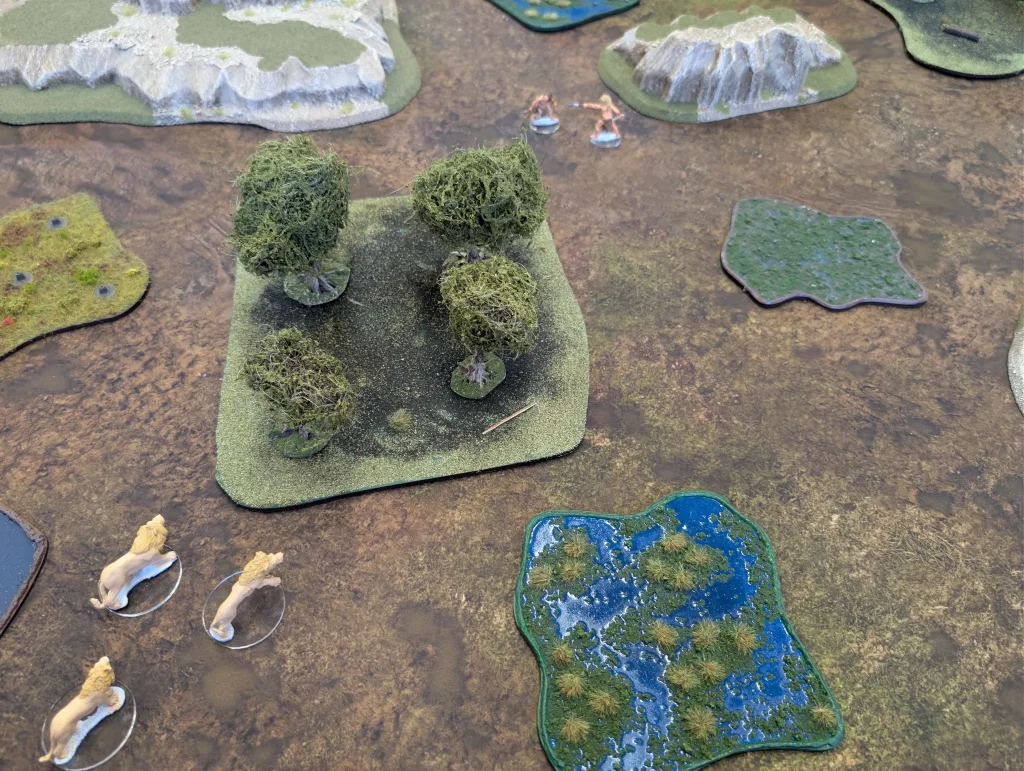
For our first game, we played a group of lions hunting some human Neanderthals. The setup for the games assumes a lot of terrain on the table – there’s no need for big open areas to fight armies in. Just a handful of humans and a few animals need to be able to make their way around and through the terrain.
Each human or animal has a stat block, and some animals have special abilities (lions can roar for instance). The different human species get different stat blocks, and Homo Sapiens are divided into hunter and gatherer types as well. We just concentrated on hunters for both species.
| Stamina | Move | Attack | Dodge | Wounds | Tough | Agility | Stress | |
| Homo Sapiens | 4 | 3″ | 1 | 2 | 2 | 5+ | 4+ | 1+ |
| Neanderthal | 3 | 4″ | 2 | 1 | 3 | 6+ | 4+ | 2+ |
Stamina determines how many actions you can do, and different actions have different point costs. So a move is one action, allowing both human types to move 12″ total in a turn (4 moves of 3″, or 3 moves of 4″). Fighting is two actions, yelling is one action, charging is 3 actions.
In our first turn, the lions sneaked around to try and locate the tasty humans. Once spotted, one of the humans tried to throw a stone at the line, but didn’t find anything suitable to pick up. A second human did find a stone – he threw it, rolling a d10 and adding their Attack skill. The lion also rolled, adding its dodge since it was aware of the attack.
The stone hit, so a roll to wound was made. This needs to roll the Toughness of the target or higher. The lion had a toughness of 7, and the roll was a failure. But the lion definitely was now aware of the humans.
Next turn, the lion roared, causing stress to all humans in 18″. It took a while to find what stress did. And this is something we had a problem with – finding the right rules at the right time. I’d only had time to skim the rules before hand, so wasn’t entirely familiar with them.
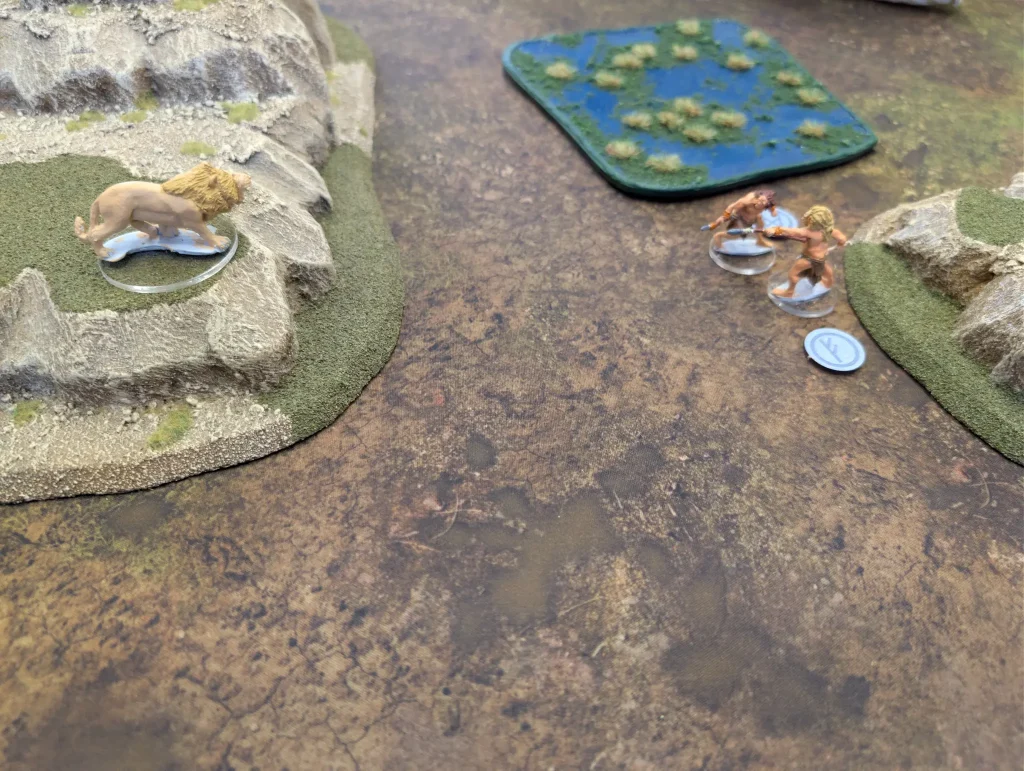
At the start of each activation, if you have 3 or more stress tokens, you need to make a stress check, rolling your stress value + number of tokens or higher. If you fail, you can end up running away.
The humans all decided to retreat to try and recover their wits, and also yelled for aid. The next turn though the lions had managed to encircle them.
The humans went for an all out attack on one lion, and poor Thrud was very quickly a casualty. Spears give a good attack bonus, plus a wounding bonus, plus have reach, allowing an attack to be made at a distance. Exactly how reach attacks work wasn’t clear – can the animal fight back? It seems that reach just means that an attack immediately ends after the first turn.
Fighting tends to last until one side is dead, or one side retreats. Both roll their attacks, plus any bonuses. Whoever wins gets to try to wound. A natural roll of 10 (on 1d10) means an extra wound is caused. Predators (such as lions) also cause another automatic wound if they win a fight. In our first fight, the lion rolled a 10 (so caused a wound), and won the fight. It successfully wounded, then caused another wound because it was a predator. Three wounds, so Thrud went down.
Ug though charged in and managed to kill the lion. The second lion came in, and was also killed. The third lion decided enough was enough, and ran off.
So our first encounter had resulted in one human casualty, but two lions killed and a third driven off.
Cave Bears and Homo Sapiens
For our second game we swapped around, with my partner taken some cave bears, and I was playing a group of Homo Sapiens. I think I need bigger bear models for the cave bears, but we made do with what I had.
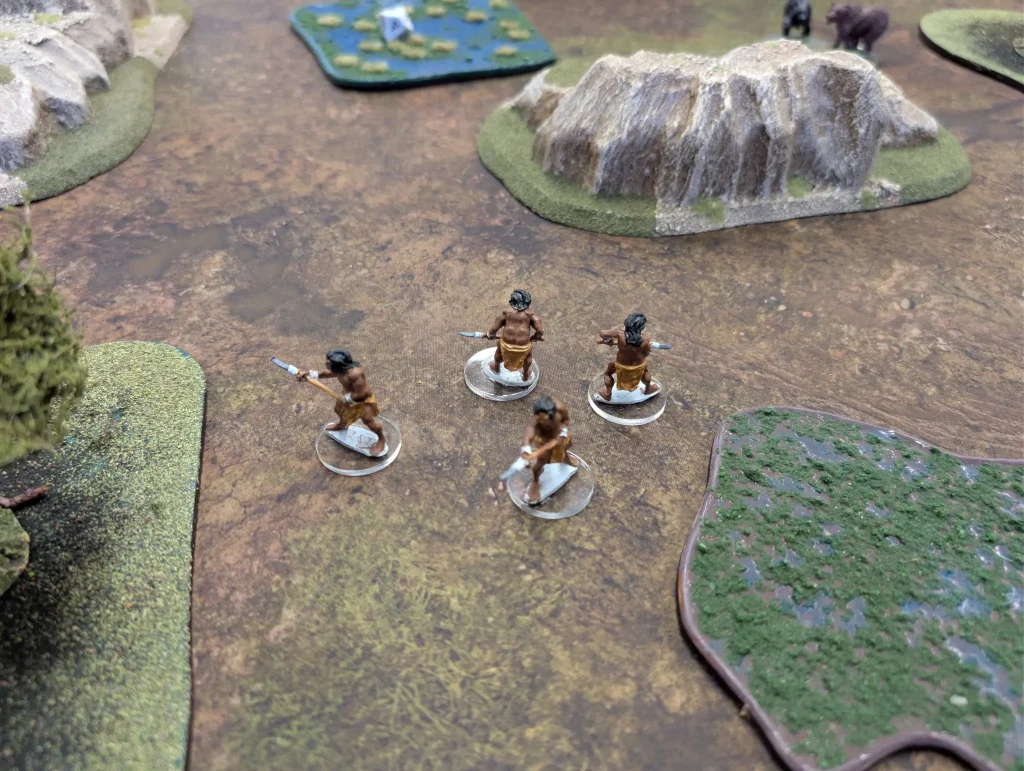
Cave Bears are tougher than lions, but my poor tribesmen were hungry and were desperate for food of any kind. The bears started by heading for some tasty fruits they’d smelled over the far end of the area, so weren’t hunting little humans.
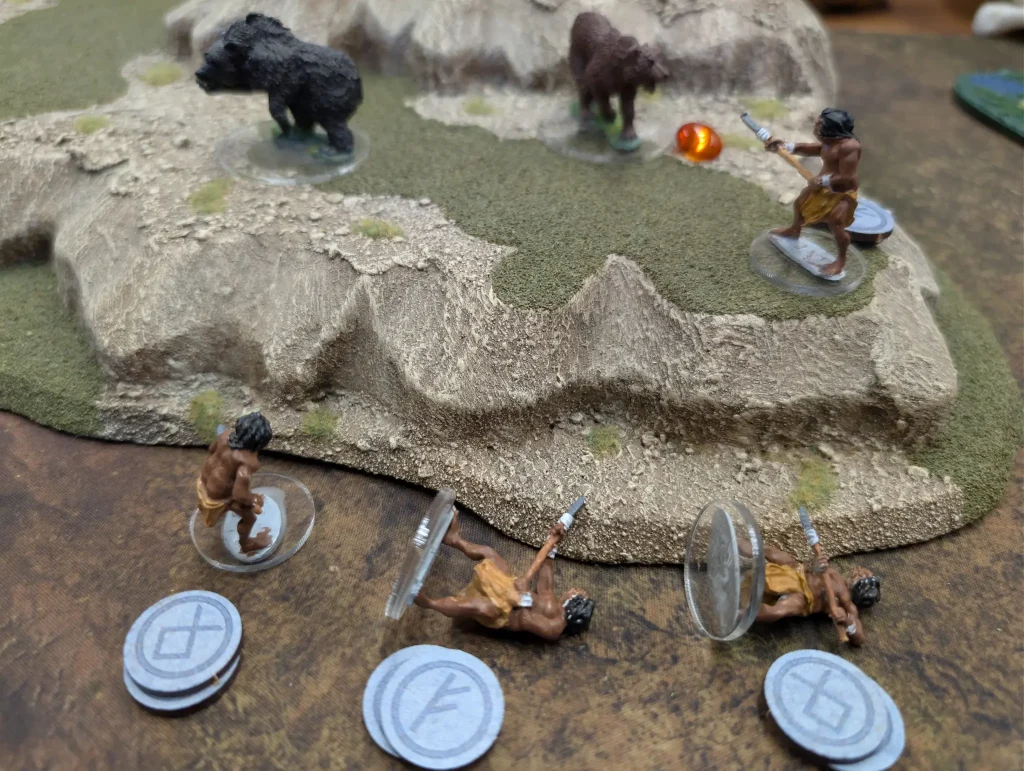
Eventually the humans tracked the bears down to where they’d climbed up onto a hill, and we tried climbing up to attack them. Both bears had roared, giving us lots of stress. Most of us fell down. One of the bears had also fallen whilst climbing, so had an injured paw by the time we reached it.
Things went badly from that point on. A cave bear has a toughness of 9, so is really hard to wound. They are also massive, so after a single attack humans have to back off. In the end, many humans were killed, and the bears survived. The surviving humans failed stress tests and ran away.
Bison Hunt
Our third game involved a couple of bison, plus two tribes of humans. Both of the tribes were hunting for food. Whether we cooperated or fought would be something to find out. For the bison, we used the Animal Instincts table, which gave random actions for animals based on what was around them.
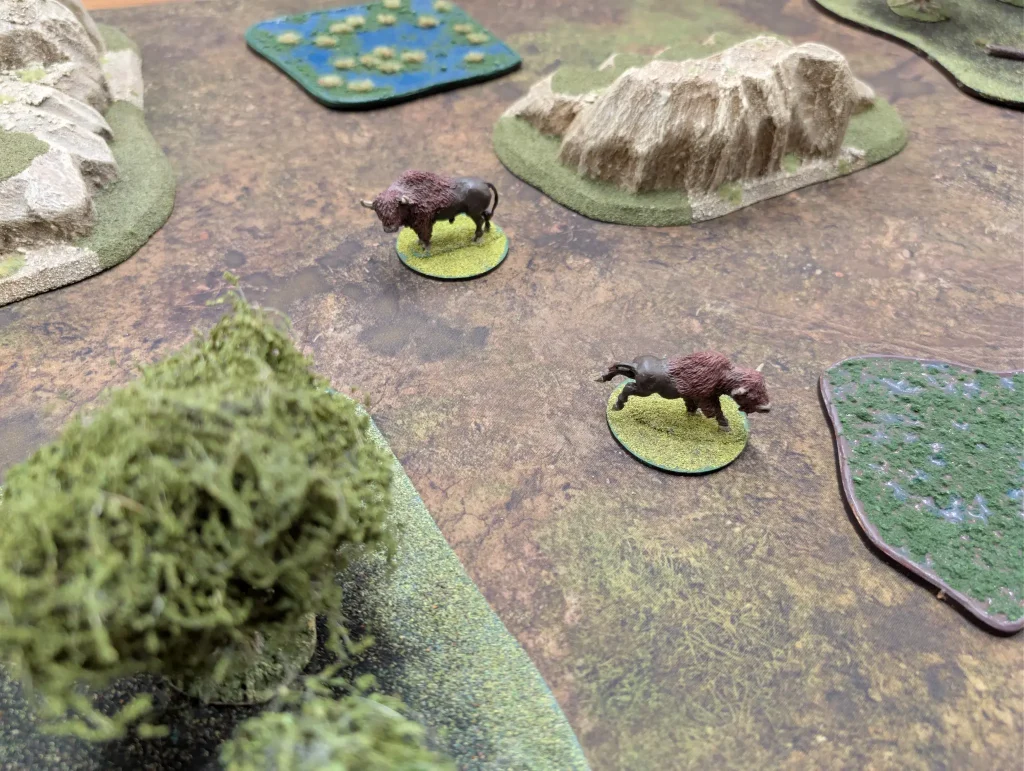
Initially, since the bison had spotted any humans, they just randomly moved around grazing. The Neanderthals got there first, charging in and stabbing with a spear. They hit, but failed to wound. Bison are also quite tough (7+ to wound), so hurting it was hard.
The Neanderthal piled in, injuring it and causing it to flee. Unfortunately for the Neanderthal, it fled over the top of them, and would have trampled them if they hadn’t made their agility checks and got out of the way.
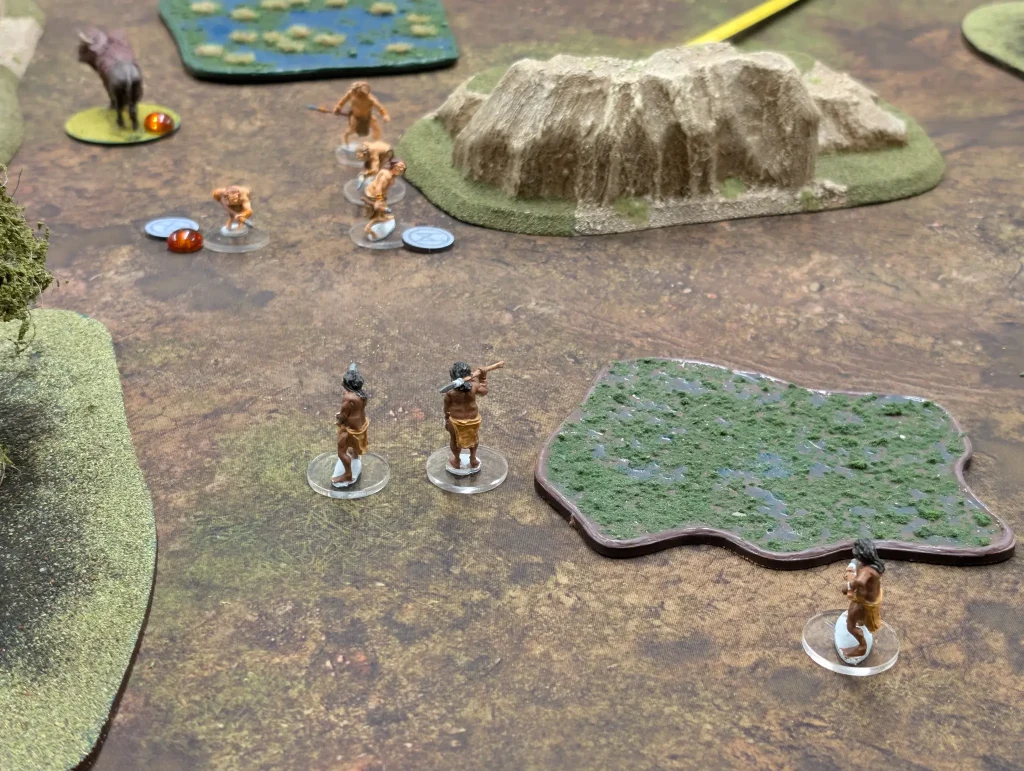
There was some confusion here as to what being prone did. Did that stop fleeing? Could you fight if you were prone? Being prone was a possible result from fighting (and falling), and there was an action to stand up again, but we couldn’t find a rule that said what being prone actually meant. It’s probably in the rules somewhere, but we couldn’t find it.
Finally the bison was taken down.
For the homo sapiens, they went after the second bison which had started running when it saw its friend being attacked. The homo sapiens couldn’t catch it – but spears can be thrown.
We got a spear into it, which maddened it. It rolled “aggressive” on the animal instincts table in its turn, and so turned around and charged at us. There was much trampling, and our Neanderthal neighbours managed to throw a spear at it, wounding it again.
Eventually the homo sapiens brought it down. We collected our spears, and both tribes went off with a bison each.
Mammoth Hunt
For our final game, we had a single tribe of Neanderthal versus a mammoth.
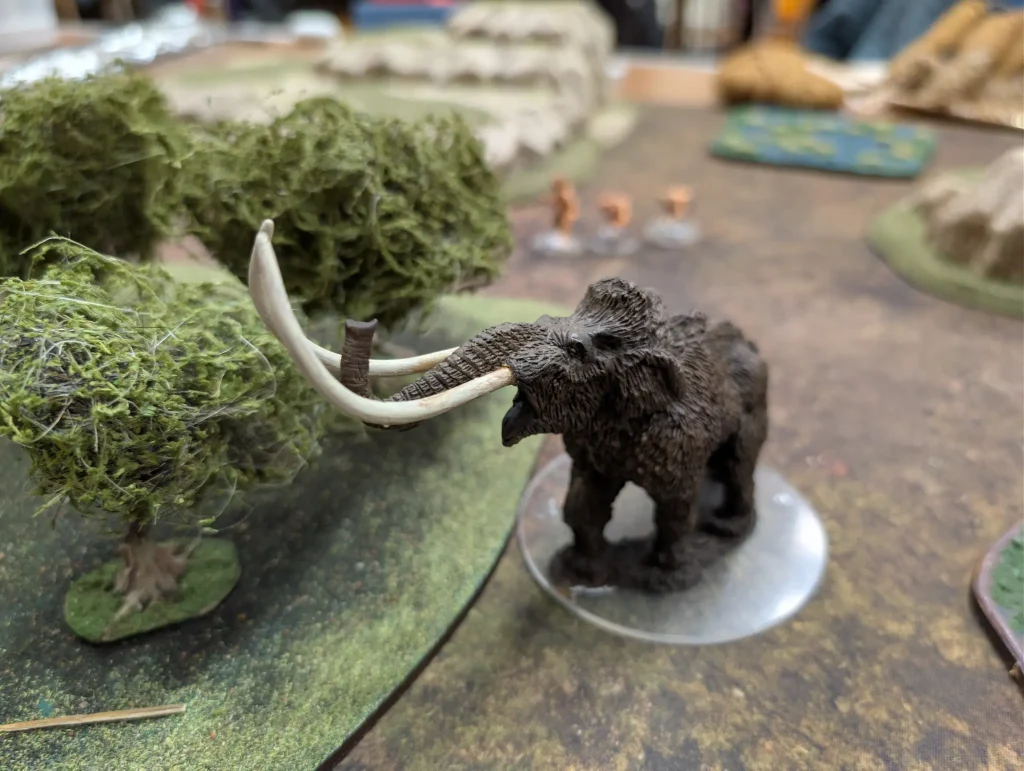
The humans managed to sneak up on it, as it was grazing, but taking down a mammoth turned out to be hard. It had an attack score of 5, and a toughness of 9, and can take 6 wounds before going down.
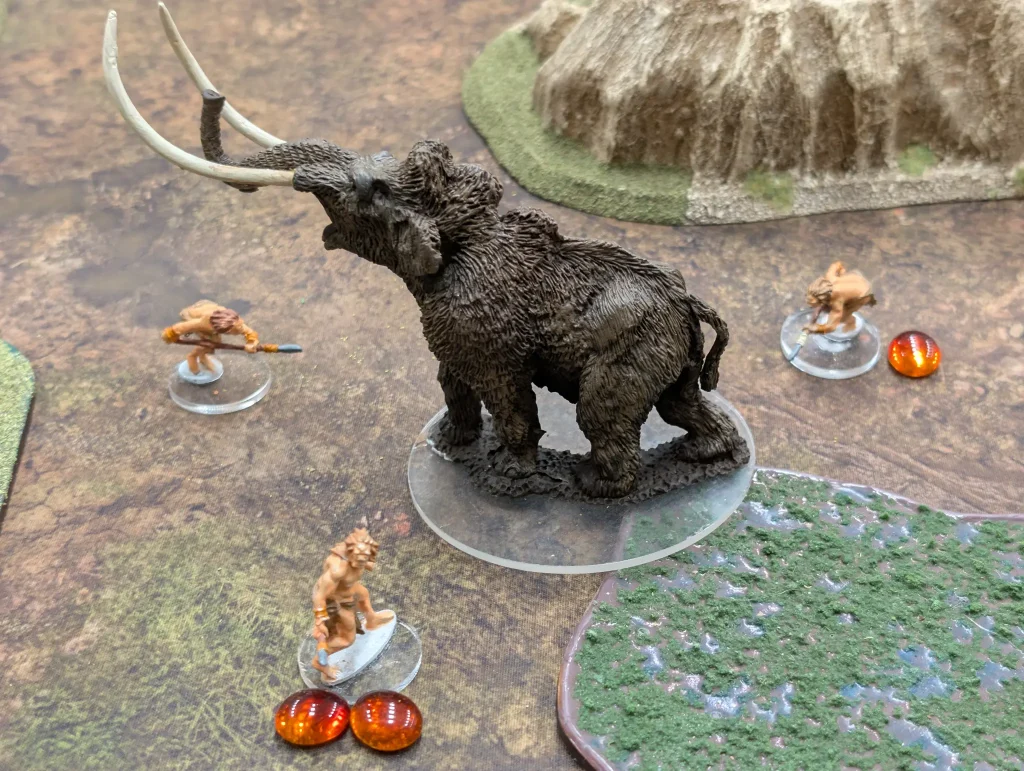
The Neanderthals managed to surround it, but ended up just getting beaten up and trampled. In the end, the mammoth fled. Everyone survived, but everyone was injured.
We managed to get in quite a few games over the course of the evening. They were relatively simple, but fun. With just a few character models each, it was possible to name our tribesmen and role play them without just treating them as pieces on the board.
The rules were relatively simple, though sometimes not entirely clear. Figuring things out may come with a bit more reading of the rules.
It’s also possible to play solo, since animals have instincts tables that can determine their actions without needing a second player to control them. One of the instincts table does seem to be broken however. The Large Prey table has results for 0-1, 4-6, 7, … – there is no row for 2-3, so we weren’t sure what that was meant to be.
Though we didn’t play the campaign rules, it may be possible to play a campaign in a single evening. Or at least several rounds of a campaign.
As well as playing Paleolithic games, there are also rules for dinosaurs and Victorians, for playing the sort of Lost World scenarios that the Tooth and Claw game assumes is the default. I have some pulp Victorian figures, as well as some dinosaurs, so this sort of scenario could be done. I do need to finish painting my Homo Sapiens, and some of the beasts before our next game though. Note that some of my Neanderthals do have red hair (I won’t use that word), but the ones that I picked out of the box didn’t. I don’t have any females or children figures – they don’t come with the packs from Footsore. Possibly I could find them elsewhere.
Overall it was a fun game, and a nice change from our usual rule sets. Since the new set of Saga errata have dropped, I’m not sure when we’ll get a chance to play this again, but it’s something I would like to play again.