Deepnight Revelation
Back in mid 2020, I started running a Traveller campaign on Roll20. I kicked things off with the Islands in the Rift adventure, so we were based in Reft sector, in the independent Island sub-sectors. During that adventure, I seeded rumours about a missing exploration vessel, and the players were interested in that hook so they ended up finding the Deepnight Endeavour. Around that time the Deepnight Revelation campaign was being published, and I mentioned it as a possibility to the players.
They were interested, so early in 2021, the characters signed up aboard the Deepnight Revelation for a mission that would last almost 5 years real time.
Very near to the start of the campaign, I got fed up with Roll20 and decided to give FoundryVTT a try. For reasons that now escape me, I decided that it would be a good idea to write my own implementation of Mongoose Traveller 2e in Foundry, so that I had something to run the campaign with. That is now public, and it seems quite a few people are using it. Yes, I’m working with Mongoose to get official content released for it. No, I don’t know when that will be.
The idea behind the Deepnight Revelation campaign, is that there is a potential existential threat to all life in the galaxy, and so a mission is mounted to find the source of the threat, investigate it and possibly destroy it. The players are crew members aboard a 75,000t heavy cruiser, with a total crew compliment of about 500. The mission will take the ship all along the Spinward side of the Great Rift, until crossing over and heading towards the Rim. It’s a 10-15 year journey at least, and takes the crew well outside of Charted Space. After that, they’ll need to get home.
For the most part, it’s a planet of the week type of campaign. You jump to a system, refuel, explore if there’s anything interesting there, then head on. There are a number of options on how to run it, but I’m going to concentrate on how we did it. What follows is my summary of how I did things, how things went, and my thoughts on the campaign as a whole.
Characters and Crew
For the crew, we went for a troupe style of play. Each player would have multiple characters (about three), and they’d be able to switch between them. The ship’s Captain and Mission Commander were NPCs, but the XO was a PC, head of Engineering and Science were PCs, and we had some ‘away team’ PCs (who were the original characters from the Islands in the Rift adventure) for when exploring planets.
This allowed the players to get involved in both mission planning, and also the more action orientated side of things without the bridge crew being the ones that always went down to the planet. For the most part, it worked reasonably well. I know that not everyone enjoys playing multiple characters, but I think this is probably the best way of running the campaign.
The biggest issue is that there are 500 crew members aboard the ship. This is a lot of NPCs. A lot to manage, but also a lot of potential opportunity.
One thing I failed to take advantage of from the start was this opportunity. There were a few named NPCs whom the players grew to know and become attached to, but that was probably less than half a dozen. I really failed to use the opportunity to tell the stories that are possible on a ship of that size.
With the ship jumping from system to system every week, there was no chance to grow attachments with any NPCs outside of the ship. There was also no chance to make decisions that might have an effect later on. If you pissed someone off on a world, or caused a war or made someone happy, then they’d be forgotten by the following week. With a planet of the week campaign, there is no chance of players seeing the consequences of their actions.
At some point towards the end, I started to try and bring the other crew members into the story a bit more, but by then I think it was too late.
I especially failed to do anything with the ship’s captain or mission commander. A couple of the high ranking NPCs got a mention (the diplomat Lord Sivas and the company woman Amelie Kaliguuan), but in hindsight, I think I should have done regular planning sessions where the leaders of the mission got an opportunity to show their personalities and goals to the players. Even if it was as simple as some handouts, with the Captain and Mission Commander setting goals for the upcoming stretch. This could have set constraints on the player’s actions (one player was the XO, so would have had the responsibility of interpreting and executing the orders), whilst allowing the players the chance to make final decisions.
So I think my advice to anyone running the campaign, is to think about turning it into a soap opera. The campaign books give some info on bringing the NPCs to life, but I don’t think it makes it clear just how important that could be.
The last Expeditions expansion book, rather than having a few random world encounters, should have been ideas of shipboard events. There are a few scripted events throughout the campaign, but a lot of them just come out of nowhere. They would be far more effective if they involved NPCs that the players already knew.
At some point I started a ship newspaper, which gave updates on the mission progress, and some little vignettes into shipboard life. Some of these gave plot hooks for the players to follow up on, some were just to try and give character to the NPCs.
Like I said, I think I didn’t do enough of this. Possibly concentrating less on the star systems and more on the crew would have been more interesting.
The Journey
Planning out the journey was going to be the tricky bit. Fortunately, I had WorldGen. This is my Traveller inspired star system generator. It goes back to 2001 or so, and has been re-written countless times. Around 2006 it got a Google Maps makeover (and was a bit like Traveller Map, due to convergent evolution), but that functionality got lost at some point since the focus was on star system creation and trade simulation, not a star map.
I had UWP data all the way out to Point Demnan (which I’d downloaded at some point in the 1990s, and can’t remember where I got it from), and was relatively easy to use that to generate my own maps. I could also use TravellerMap out to this point, but WorldGen creates whole star systems, generates surface maps for all planets and moons, and creates some random text describing each world and its inhabitants.
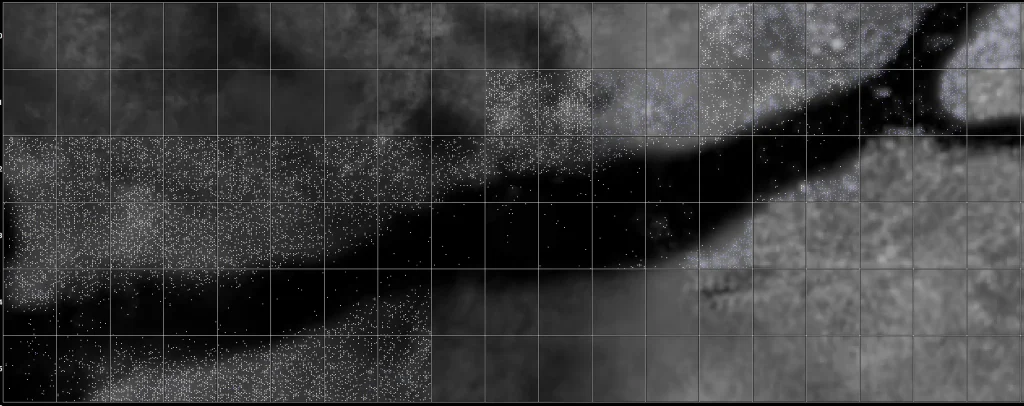
Beyond Point Demnan, there was no UWP data, but WorldGen can generate whole random sectors using just a density map (shades of grey to represent chance of a star system), so I was able to use that to populate all sectors between Point Demnan and the Near Side of Yonder.
If I hadn’t had that, I have no idea how I would have run things. Generating systems by hands seems like a complete nightmare, and I don’t have much advice for anyone going down that route. I guess you’d only generate the systems that the ship was visiting, but even so, that’s a lot of systems.
I did modify my software to implement a survey system, so players could only see systems that they’d scanned, and that the level of scanning controlled how much detail they could see. This again really simplified navigation, and meant the map auto revealed itself as things went on. In total, my database of worlds is now a 702GB MySQL database. It has data on 30,948 star systems, 161,202 worlds and 313,470 moons. Total population of these worlds is just under six trillion.
Another option might be to skip over the boring systems. I played through every single system that the ship visited. Some systems might only take 30 seconds or maybe a few minutes, but we’d rarely visit more than half a dozen systems per session. Sometimes we’d spend a couple of sessions in a system. So progress was relatively slow in turns of the amount of game time. I think our sessions are probably a bit on the short side as well. Normally they’d last about 2½ hours, maybe 3 hours.
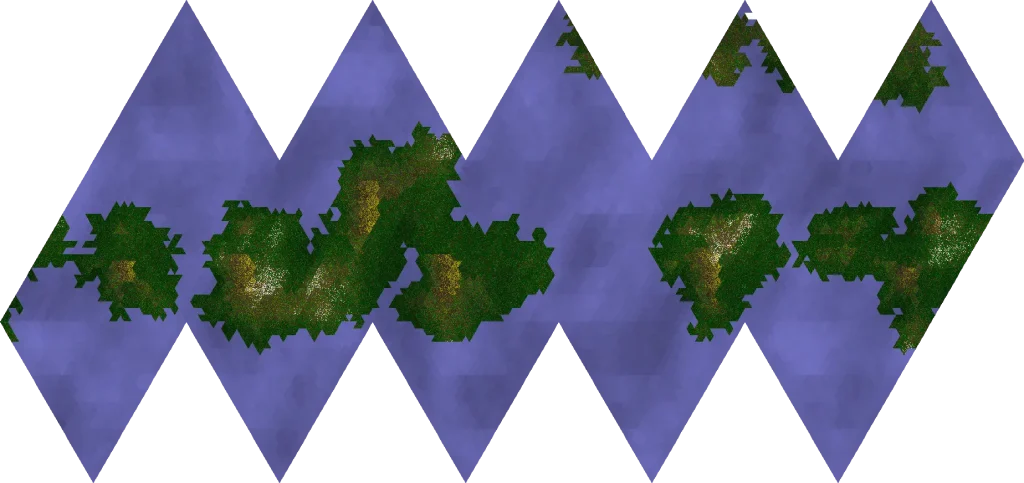
Since the worlds had random descriptions, it gave me something to riff off as the players visited them. The systems that were inhabited would have some descriptions of the species and their culture. Though basic and sometimes repetitive, again it gave me something to build stories from.
The trip up until Point Demnan was interesting because there is a reasonable amount of material on the regions in this part of space. Not a lot, but enough for me to base some stories off.
From Point Demnan until the Near Side of Yonder was mostly my own inventions, but it was also probably the most interesting part of the entire campaign. I wasn’t having to fit the player’s actions into what the campaign wanted me to do. There were no scripts to follow, so I had a reasonable amount of freedom in how I ran things.
The campaign was also still reasonably new, so there wasn’t any feeling of things getting boring. Indeed, I’d almost suggest that the campaign destination be set as the Near Side of Yonder, on this side of the rift. It’s a long campaign, but not that long, and doesn’t feel like it’s overstaying its welcome.
The Rifts Edge Transit book had some good small situations in it, as well as a bit of an introduction to the previous Droyne mission, and the nature of the Entity. There were no restrictions on where to slot things in though, and for the players it was very much an exploration mission. Which is what they’d signed up for.
The Big Settings
The Near Side of Yonder book introduced a couple of complete alien civilisations, as well as a big story event. This was actually quite interesting. The Erline were an interesting species, and for my campaign this part of the story worked quite well. Though the players were interested in what was happening, they were very careful about taking risks. How they saw it, was that they only had a single ship, and losing that would be the end of the campaign. So they did everything to ensure that they didn’t lose it.
If the Erline and the Tenipal had been at risk of annihilation by the Entity, and point VS-X was located here, then I think things could have been more interesting. The players would have had a civilisation to rescue, and a reason to take risks and do something about it.
As it was, as time went on, the players forgot about their mission. To be honest, I pretty much did as well. The journey became the adventure, and the goal of the adventure became something that wasn’t actually being sought out.
The Crossing book wasn’t that exciting, and I barely remember the details in it. I think I skipped over much of it. There were some on-board ship storylines, but as I said earlier I think they needed to be brought up sooner so that players cared about the NPCs. Possibly that’s a failing on my part.
The players were also very actively trying to ensure morale was high, and that the ship was in good condition. This meant I ended up ignoring or downplaying some of the plot lines that the adventure tried to force on the ship.
The Far Side of Nowhere again had an interesting civilisation, and one that might be worth setting a campaign in. However, for me it didn’t feel necessary to the campaign. It was a big complication, tried to enforce some situations, and we mostly skipped lightly over it.
I did get a chance to do a big social event here, but that wasn’t something in the official campaign. Just something I built up from some of the ideas. It was also an opportunity to swap out some of the crew. Those who didn’t want to continue could stay with the humans here, and some new crew members were brought on board.
This was the point at which I started trying to introduce more named NPCs, but it was something I needed a lot more practice with. I’m not skilled at bringing lots of NPCs to life unless they are part of some agenda. For the crew, there wasn’t much opportunity for different people to have agendas outside of personal relationships. So I struggled a bit.
Overall though, I would have been happy with just having these sectors as empty space.
The Voidshore book was I think a big disappointment. The Biologicals were unnecessary, and mostly avoided by my players. A big question that I kept on getting ask was “why should we care?” I didn’t really know what to do with them, and this is where there was a huge disparity between the players in my game, and the players the adventures had been written for.
From the start, my players had been really cautious. They carefully scanned worlds and sent down probes rather than setting foot themselves. As they saw it, they had but a single ship, and a limited number of crew. Risking the ship was seen as a stupid thing to do. Risking crew members was also something to be avoided.
A lot of the Biological plot lines assumed the crew went down to the planet’s surface and explored things themselves. Unless they thought that there was something big to be gained by doing this though, my players avoided doing this whenever they could.
By this point, I was also getting a bit tired of things, and started escalating the situation. There were worlds with Entity infested Stage Trees, and giant world building machines left by the Droyne. I was trying to keep myself from getting bored with the adventure.
The player’s refusal to engage with things was also starting to annoy me, since it meant there wasn’t anything interesting for me to run. Just giving reports on what probes had found was a lot more boring than running a risky exploration scenario. The players were being sensible, but there’s a reason characters in horror films often do risky things. If they don’t, there’s no film.
By this point it was also abundantly clear that we’d all lost sight of the main aim of the mission. Was this a seek and destroy mission, or simply a take a look and head home mission? If this was meant to be a military mission, why did they have a demilitarised ship, and why didn’t they have a small war fleet? If the Entity was really a big threat that needed to be dealt with now, rather than in another 30 to 50 years time, then the Imperium would have sent a much more capable mission.
Which is one reason I think having a shorter campaign, and making the Entity an immediate threat to people the players cared about would have worked better. At least for me.
One bit of the Voidshore books I did like were the Solomani ships. They added a bit of a break into the journey, and game some new NPCs to play with who had an outside agenda.
I really struggled with the positioning of some elements. I wasn’t entirely certain where the destination was meant to be. Some of the Droyne locations weren’t on any maps. If they’re locked down, it gives me something concrete to play with, plus the option to change things. If they’re ambiguous, then I’m left trying to piece together clues and hoping that I don’t contradict something that comes later.
Terminus
I tried adding a few civilisations that were being manipulated by the Entity as things drew to a close, to try and talk up the potential threat. I’m not entirely sure it worked.
By the time that the ship reached its destination, the players were not really wanting to engage. It seemed too dangerous, the possible gains were too few, and the sensible choice seemed to be to go back home with the information gained. Let a second fleet which was better forewarned and better armed to deal with the problem.
I did end up pushing things a bit. The alternative would be playing the journey back home, which I really didn’t want to do. If the players had decided to head home, I would have ended the campaign with a “and you head home”. Which I think would have been a bit of a let down.
But the players in the end took the hints and completed the mission, so the campaign ended pretty much how it was written.
Overall Thoughts
There were definitely bits that I got wrong in the campaign. Not using the NPCs to be best of their usefulness was probably the biggest mistake.
Not having a good and strong mission statement, which could be referred to at various points, especially towards the end. The entire campaign lasted almost 5 years real time – it was easy for everyone to forget what they were meant to be doing.
The campaign could be shortened by skipping faster over systems. Maybe just design a few systems per sector, and narrate the rest as “you travel a dozen systems, then find a world with X” where X is something worth stopping for and investigating. I could present a map with all the systems pre-designed, so it was easy to play out every star system. But maybe this isn’t entirely necessary.
Having planning meetings for the bridge crew and officers, to push their view on the mission and to show case their agendas, might have been a workable plan. If I ever do anything like this again, I’d definitely give this a try. Though I wouldn’t run Deepnight again, a Naval campaign with the characters as crew on a large military vessel might be interesting. It would be a much shorter campaign. with a much stronger chain of command.
I needed more shipboard events to keep things occupied. You could have the ship passing through an entire sector, and only detail things going on amongst the crew. Maybe some faction system which the players could try to manipulate depending on how they wanted things to go.
There were a few good recurring things. We had a zero-g ball game which the crew introduced to several worlds, and it was a running theme about who was playing the game, and who was cheating. This was spun out of one of the written plot lines in the adventure, and acted as a good distraction on multiple occasions.
At one point they picked up an alien pre-sophont bird, who became a major NPC despite having a very limited vocabulary. A couple of the NPCs became liked through random chance (one portrait looked a bit like Gaius Baltar from the Battlestar Galactica reboot, so he took on Baltar’s personality).
The bits that seemed to work best were the ones I came up with. I’m used to running my own stuff. I ran Rise of the Runelords recently, but that has been an exception. Since the 1980s, I’ve mostly run my own adventures and have ignored published adventure modules. If I create a story, then I have a good understanding of why everything is happening. For a written module, I struggle to fill in the gaps because the written bits were done by someone else, so don’t quite fit how my mind works.
Some of the mechanics I found burdensome and dropped. There are rules for the decay of the ship, but I ended up not using them. They seemed quite harsh, and I didn’t want to keep track of them. The concept of a Reach wasn’t clearly defined enough for me, so I didn’t use those either. Maybe they could have become more useful if I’d used briefings to plan them out.
One final thing, is that this campaign has probably had the least combat of any campaign that I’ve ever run. We may have had at most one or two combats a year (real time years) throughout the campaign. Most of it was exploration, with a bit of social. It’s had the downside that my FoundryVTT system hasn’t had a huge amount of testing for combat. It’s not something we do very much of.
But Was It Good?
Overall, it was good campaign. It wasn’t perfect, and I think some parts of the written material didn’t fit our group as well as they were meant to. For GMs, thinking hard about how the ending is going to be approached, and what the players might actually want to do when they get there is important. As I’ve said multiple times already, we lost focus on the campaign objectives, and I think that hurt things.
Though there is the choice of just heading back after getting information on what is at Terminus, I wouldn’t want to spend another few years running the campaign on the way back.
It was definitely an interesting and memorable experience however. We did most of it with just two players. I would have preferred more, but that also had some advantages. Notably, it’s easier to get agreement on what to do. However, it also puts a lot more stress on everyone to have to contribute. It was fun for most of the campaign, but it had possibly outstayed its welcome by the end.
Whether you need all the books depends on your style. They all have some good bits (well, maybe not Crossing), but which bits work best will depend on your group. Steal what works, ignore what doesn’t. I actually liked the Far Side of Nowhere as a setting, even if I didn’t feel that it fitted the campaign.
I want to run some more Traveller (I already have some plans in mind, and I’m putting a group together). I want it to be more normal though. Back to running between the same worlds, trading and dealing with things which have limited scope so that I can build up a sandbox in which to set stories and events which have consequences. I definitely don’t want to do another big campaign just yet (so Pirates of Drinax is right out, which is unfortunate). Just something of my own making, which I have full control over.
If you’ve made it this far, then congratulations. If you’ve been reading from the start of the campaign, then I’m really impressed.
My take on the campaign has been the somewhat dry version though. My players started a Google Doc called The Exciting Voyages of the It’s A Sex Thing back during the Islands in the Rift adventure. They kept updating it throughout the campaign, and it’s 120 pages of what really happened aboard the Deepnight Revelation. Let’s just say it’s a lot less serious, and a lot more amusing than what I ever wrote.

Many thanks for sharing this epic story, as well as tour thoughts on how to improve on the campaign material. I’m currently running it for three players and have already drawn lots of inspiration from your posts. We’ve just finished the resupply stop at Demnan – more time for the crew NPCs is advice I’ll definitely take on board !
Very much enjoyed reading this over past few years. Traveller content is hard to find, and this was a fun campaign to follow! Thanks for the critical look at the material as well.
The Deepnight Revelation books are so massive in scope that they almost seemed like they were intended to be read instead of played, so it was very impressive to see it done, especially documented so thoroughly.