More Feasting and Pillaging
Last week we had a Saga: Age of Vikings game of the Feasting and Pillaging scenario. My Welsh were heavily defeated by the Anglo-Danes. This week, I was playing again, this time with Age of Invasions factions, with my Saxons up against some Romans.
Having an all-infantry army was going to be a lot easier than a mostly mounted army, or at least I hoped. I may have played the Saxons once or twice before, but it’s been a while and I didn’t really remember how to play them. My Saxon army consisted of Early Saxon metal figures from Footsore:
- Warlord
- Hearthguards x4 (2x units of 6, 1x unit of 4)
- Levee (Archers) x1
- Warriors x1
I was up against the Romans with the following units:
- Warlord
- Hearthguard Cataphracts x2
- Hearthguard x1
- Warriors (Archers) x2
- Warriors x1
I’d chosen a mostly hearthguard Saxon army, because several abilities only work if you have higher armour than the enemy, so starting with high armour seemed prudent. They also get no bonuses for shooting attacks, so taking more than 1 unit of missile troops didn’t seem worth it. Possibly I could completely get rid of the archers and replace with some warriors.
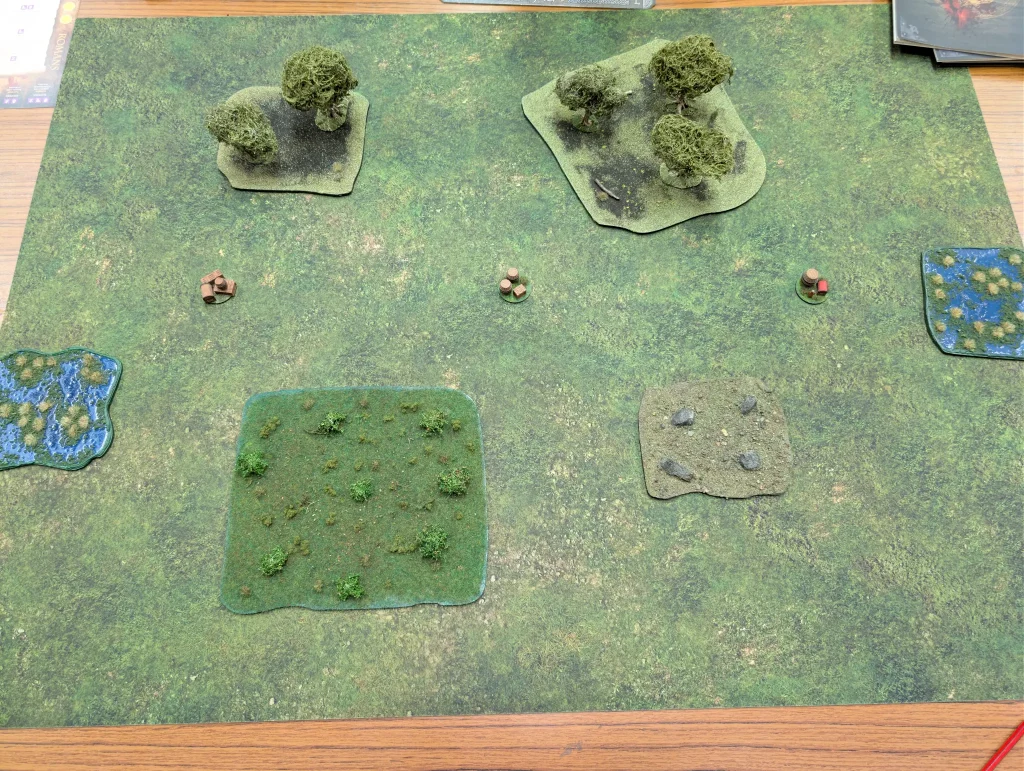
We ended up with a table with quite heavy amounts of terrain, which I think benefited me. As before, there were three objective markers along the middle line of the table, and the aim was to grab as many as we could and get them off our side of the table. Carrying an objective counted as moving through uneven terrain, so you would move only S, and mounted units would also gain fatigue.
Turn 1
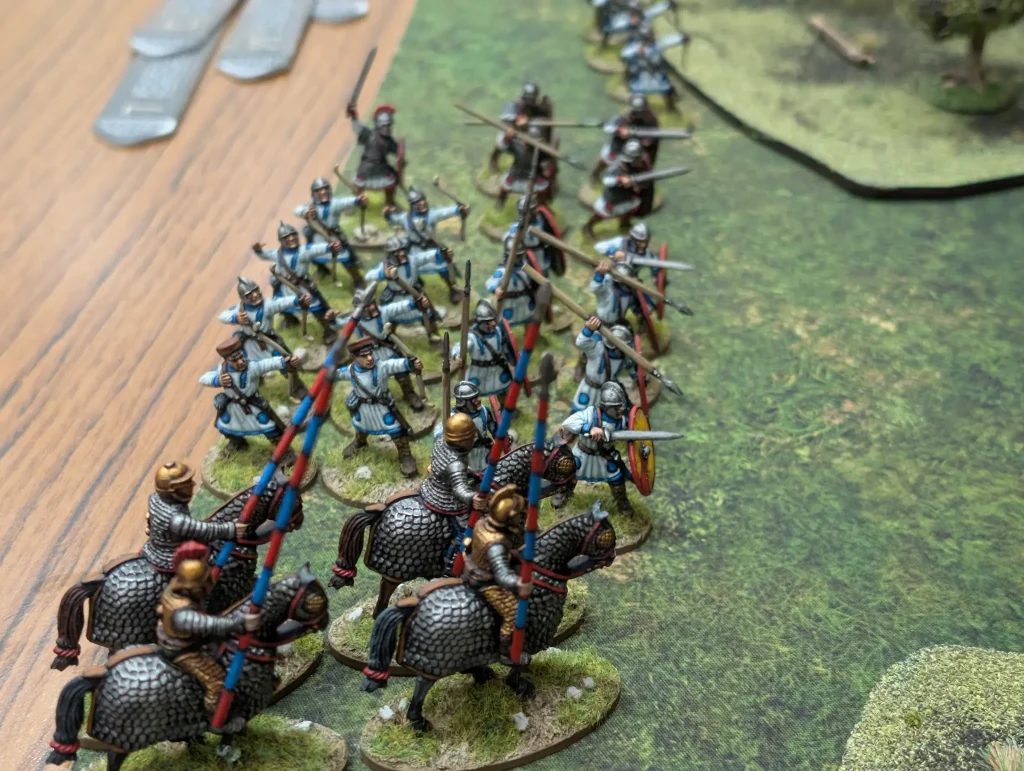
The Romans went first, taking only 3 saga dice on their first turn. They used manoeuvre to advance up the table a bit, but didn’t make a lot of progress. The Roman figures were from the plastic Gripping Beast range, and they looked really nice.
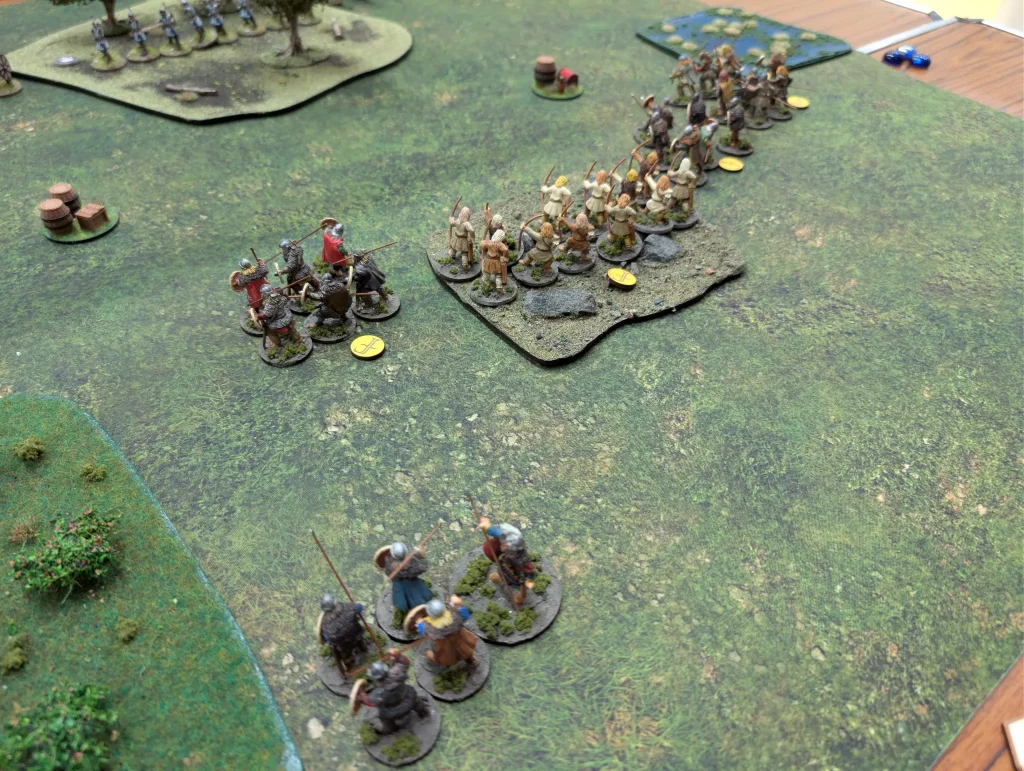
The Saxons planned on not engaging in combat in the first couple of turns, so took a risk and moved fast to try and secure the objectives. I aimed for two objectives, leaving the third for the Romans to take. I didn’t grab any this turn, and I gained a bit of fatigue, but it put me close.
My plan was to use my two units of 6 hearthguard as aggressive front rank units, and keep the unit of 4 hearthguard back as bodyguards for my Warlord. My Levees I moved into the rocky ground to give them some control over the middle of the table from solid cover.
Turn 2
The Romans did their Orders phase, then I played Vivacity as an Orders/Reaction, allowing me to activate two units for a move. This allowed me to grab both of my targeted objectives with a unit of 6 hearthguard and a unit of warriors. I was expecting heavy counter charged from the Romans at this point though, so wasn’t expecting to keep both of them for long.
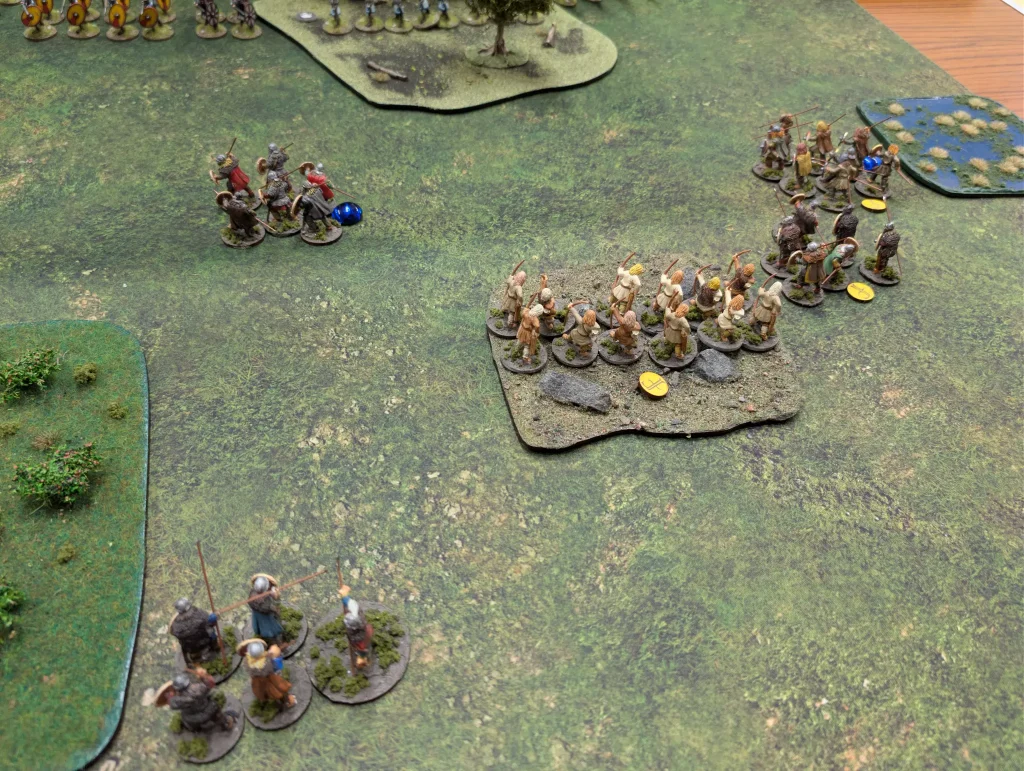
However, the Romans didn’t quite have the right dice to do this. Most of their units moved forward, close enough to use Plumbatae against my central hearthguard – getting no hits. They then used combined formation against the same – getting two hits but no kills.
So it was back to the Saxons’ actual turn, and I had been expecting to be fighting over those two objectives by this point. I had especially feared that the unit of cataphracts would have charged my warriors. I could stay and prepare, or, having grabbed two thirds of the objectives, I could just be a coward and fall back.
The Romans played Foedus on three of my units during their Orders/Reaction phase, which meant that i would gain extra fatigue for any melee or shooting that those units got involved with. This can be a powerful ability to discourage the enemy from attacking.
In this case, it really persuaded me that staying and fighting was not going to be a good idea. So I stuck to the scenario goals and started an orderly retreat carrying two of the objective markers.
Turn 3
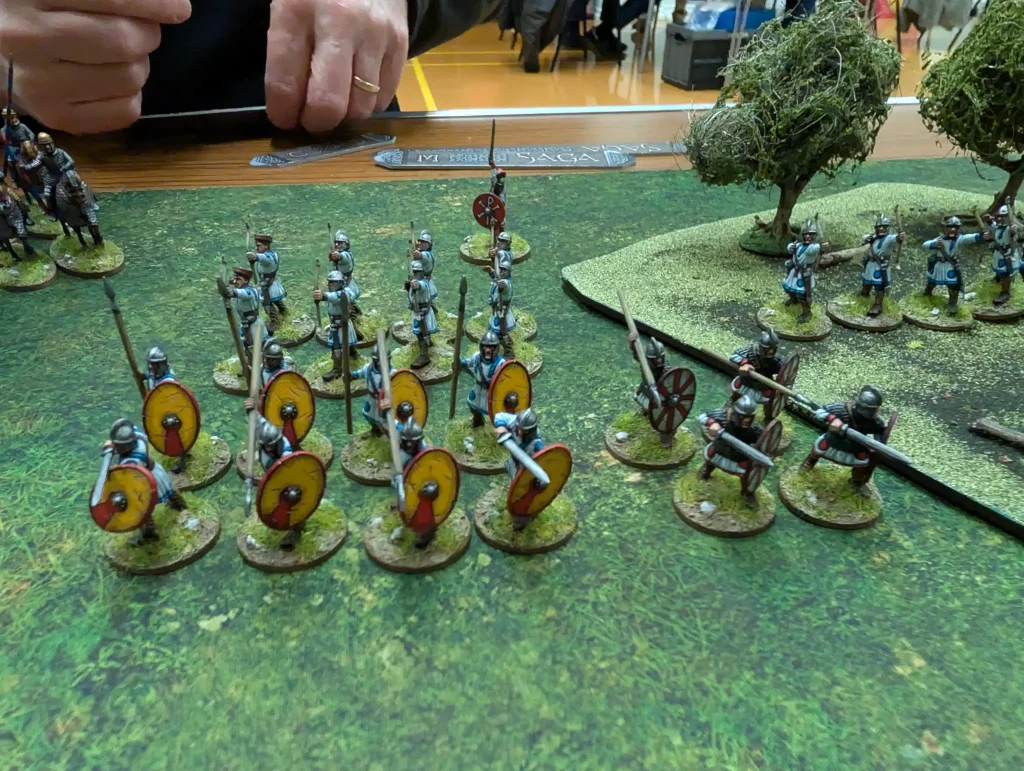
It was the Romans turn, and so of course the Saxons used their Vivacity to move during the enemy turn again. I used this once again to pull back my warriors and hearthguards who had the objectives. The Romans used Rallying Cry to recharge their Imputus.
The Roman archers in the woods moved up to the edge, and shot at my hearthguard,. I used Jeers which would give them fatigue if any of my figures were killed. They got one hit, and one kill. So the Romans also gained a fatigue.
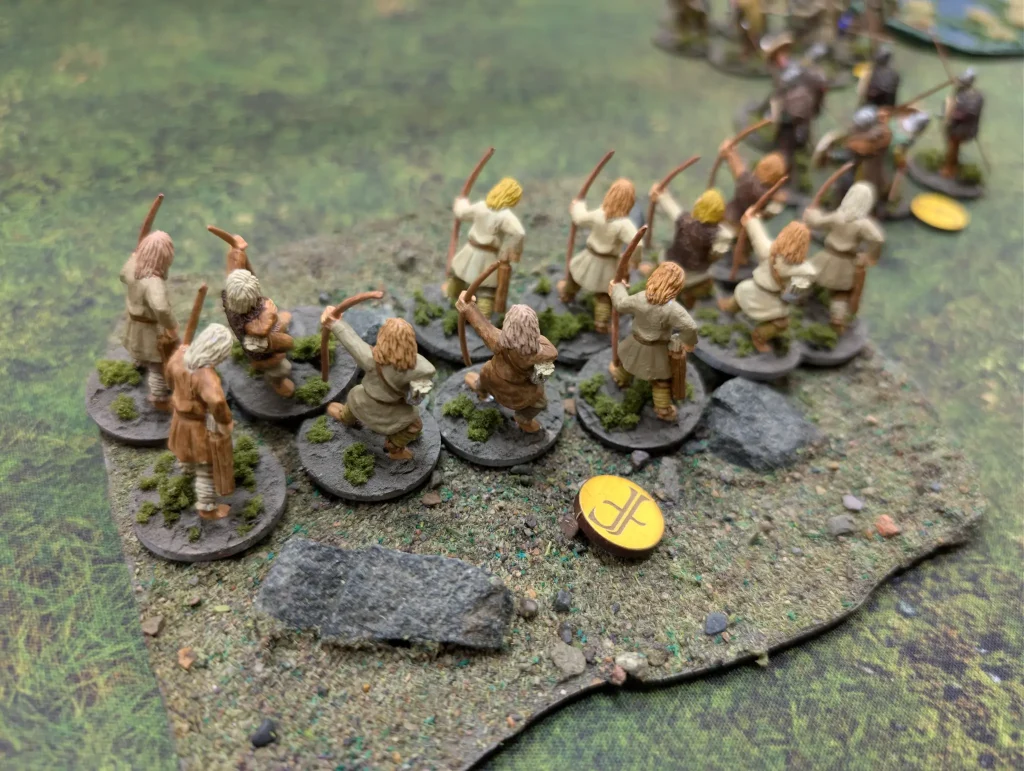
The cataphracts manoeuvred forward, and Combined Formation was used against my archers hiding in the rocky ground. This gave them hard cover, so there was only a single hit and a single kill.
On the Saxons turn, the Romans played Foedus again, on my archers and hearthguards. But all my units, other than the Levee (who I left behind to defend themselves) moved backwards towards the table edge.
My archers took some shots at the Roman hearthguard infantry, but got no kills.
I felt bad at this point, because I was running away without much of a fight. But I had two objectives, and if I could get them back off my table edge without losing too many figures, it would be a clear victory. It seemed silly to stay and fight just for the sake of it.
Turn 4
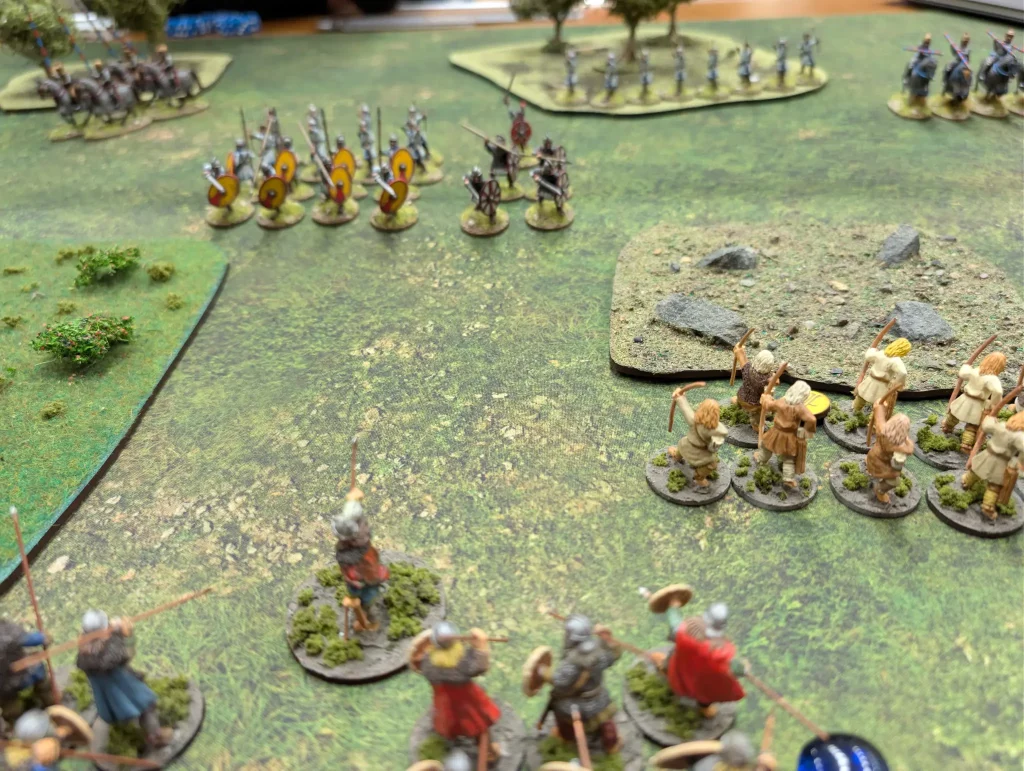
It was the Romans, so the Saxons used Vivacity, moving their Levee back out of the rocky ground, and moving the warriors with the first objective marker off the table.
The Romans used Rallying Cry as well, and moved forward. With Combined Formation, they were unable to score any hits.
The Saxons could now get all their units off the table. That gave me +12 points just from the two objective markers. The Romans would be able to grab the third objective, but would struggle to get it off the table. Even if they did, it would only give them +6 points. They were more likely to just get +3 though. I was down a single Hearthguard and a single Levee, which wouldn’t be enough to even things up.
So victory went to the Saxons, without hardly a fight. Must useful ability in the game I think goes to Vivacity. It gives two extra movement activations, effectively without fatigue. It can allow Saxons to be really aggressive, getting into combat quickly. In this case, it was really useful for avoiding unnecessary combat.
This was an interesting game, even though there wasn’t much of a fight. In this case, the Saxons turned out to be well suited to the scenario – being able to move in their opponent’s turn greatly accelerated their ability to retrieve the objectives. The Romans bad luck at the start meant that they couldn’t engage the Saxons quickly enough.
So the game was over quite quickly, which meant we had time for a second game.
For our second game, we just faced off on the table and went head to head in a straight up grand melee. I didn’t take notes for this, since it was really just a chance to see how the two armies faired when actually fighting each other directly.
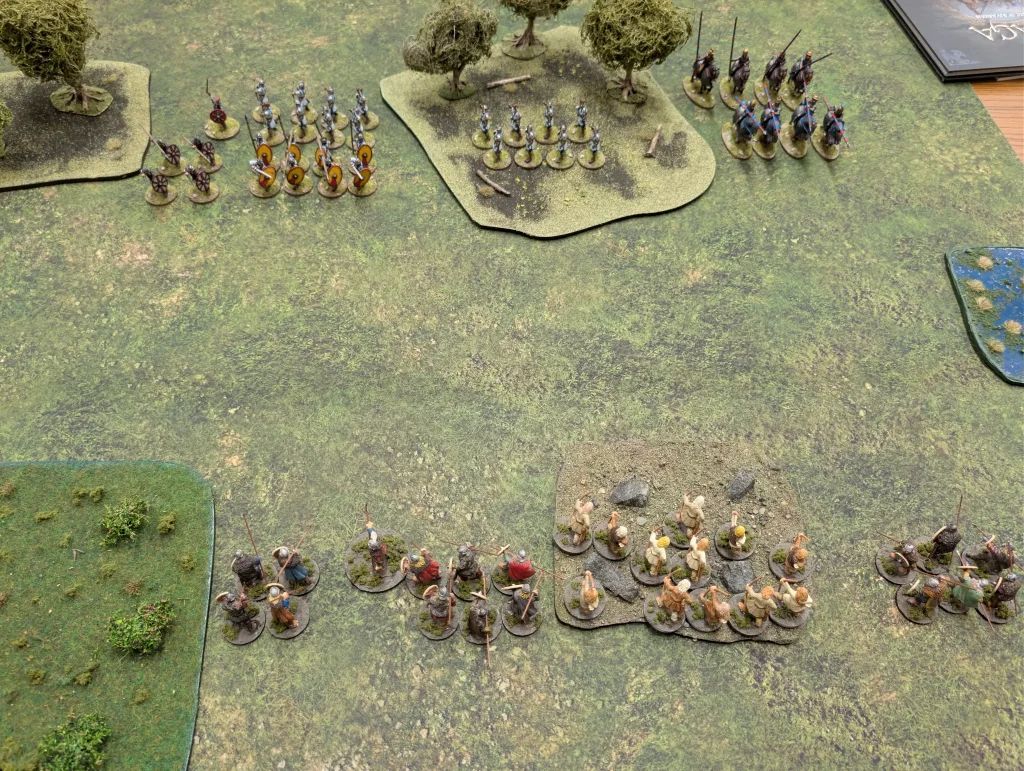
I charged the Saxons in, straight into combat, and did a lot of damage. I wiped out one unit of Warriors, and exhausted their warlord in the first couple of turns. But ultimately, the attack was turned back and I lost 10 hearthguard. The Saxons can get a lot of extra attack dice, especially if they have good armour.
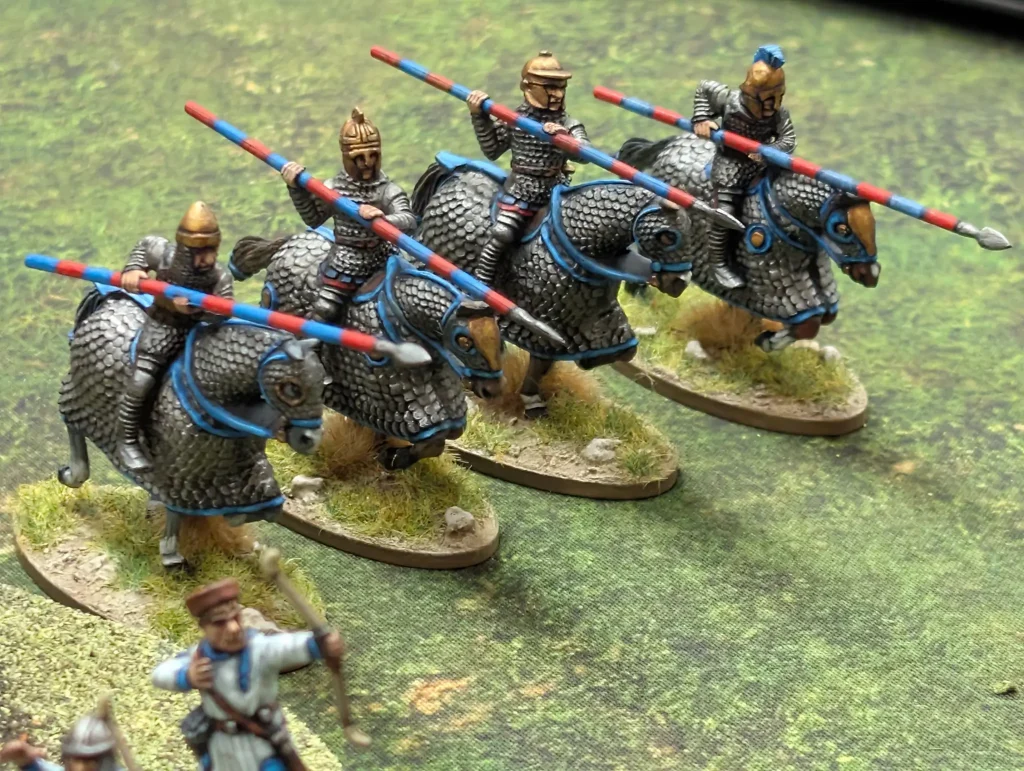
The Romans closing ranks, and using Plumbatæ and Combined Formation to soften up my units was in the end pretty effective though. I think the Roman faction is very good at working together, holding the line, and just wearing down the enemy.
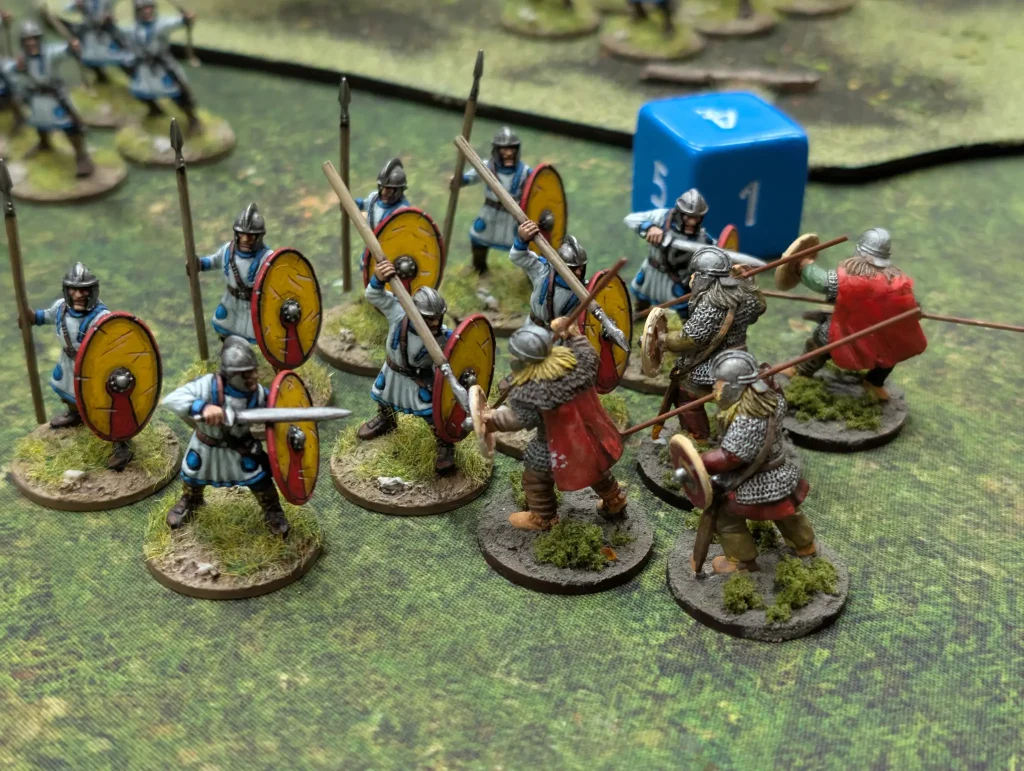
There are some nice aggressive abilities which the Saxons have, but my opponent managed his Imputus really well, and always seemed to have enough to do what was required. In this second game, it was a lot bloodier, but ultimately the Saxons lost.
I think the Saxons would be an interesting faction to use in a Limes campaign. They are quite easy to play, and good at moving fast, which would make it hard for the defending faction to hold them off. In this case the Romans could still work as the civilised faction. The Romans and Saxons fought in Britain early on, and also on the continent where the Saxons were part of several waves of Barbarians.
At some point, the Romans in Britain become Romano British, which are represented as the Britons faction.
A game focused in the Rhine region, with a mix of Saxon, Frankish and Huns as the Barbarian factions fighting against a Roman army could be interesting.