Somewhere in Estonia
It wasn’t actually in Estonia, since when I checked there wasn’t any terrain that matched what I wanted. Estonia is pretty flat near the Russian border, and doesn’t seem to have any nice hilly valleys. But the idea was there. After a very long break, we were back to Dirtside II, playing a scenario between Russians and NATO forces.
When I last ran this, a couple of years ago, the idea had been to use the Dirtside II rules to run scenarios in the near future, with a mix of modern vehicles extended out a few decades to include some SciFi elements. Since then though, I’ve been moving things backwards, and now what I have is pretty much just modern day stuff, aiming more for a Twilight 2000 sort of feel to the game. This is partly brought on by getting the new Twilight 2000 RPG rules, which are now set in an alternate timeline (where the Soviet Union didn’t fall, and Nuclear war happened in the 1990s).
This means that I could switch to a game system that was already focused on modern combat, but I’ve started with Dirtside, and I kind of like the rules. Maybe at some point I’ll try things with a different set of rules (I have a few that I’ve looked at), but for this game we were back to Dirtside.
Since it’s been a while since we last played, this game was very much just an attempt to remember how the rules worked, and figure out how the two sides played against each other. There was no artillery, I don’t have rules for small drones yet, and we had limited use of aircraft.
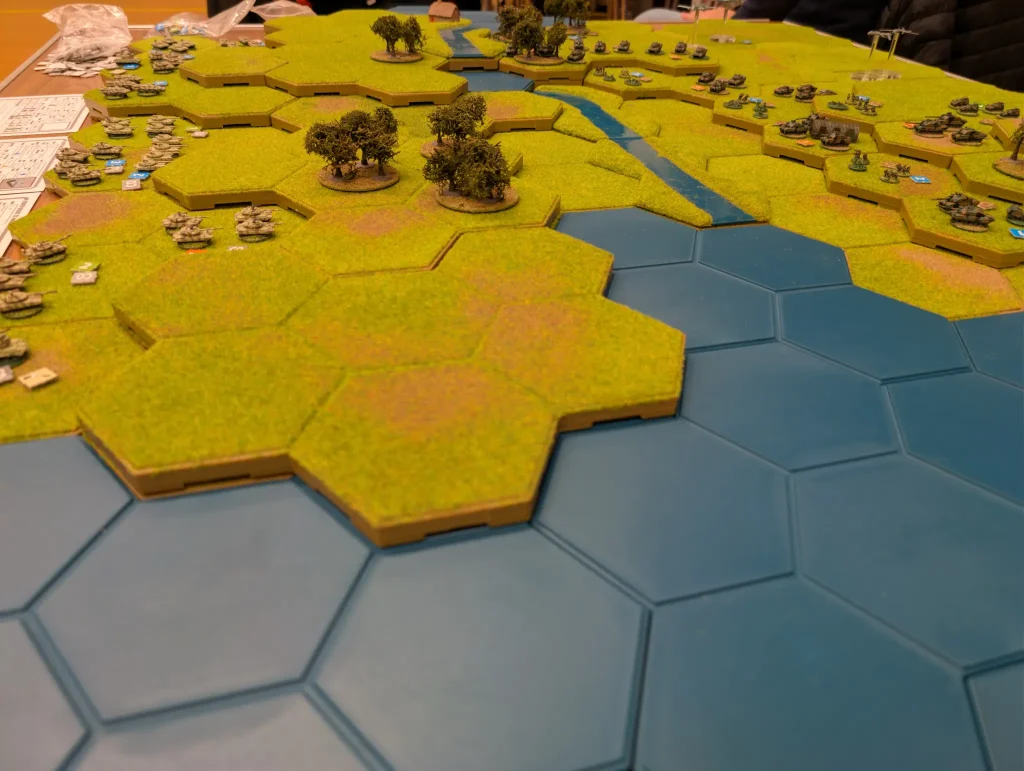
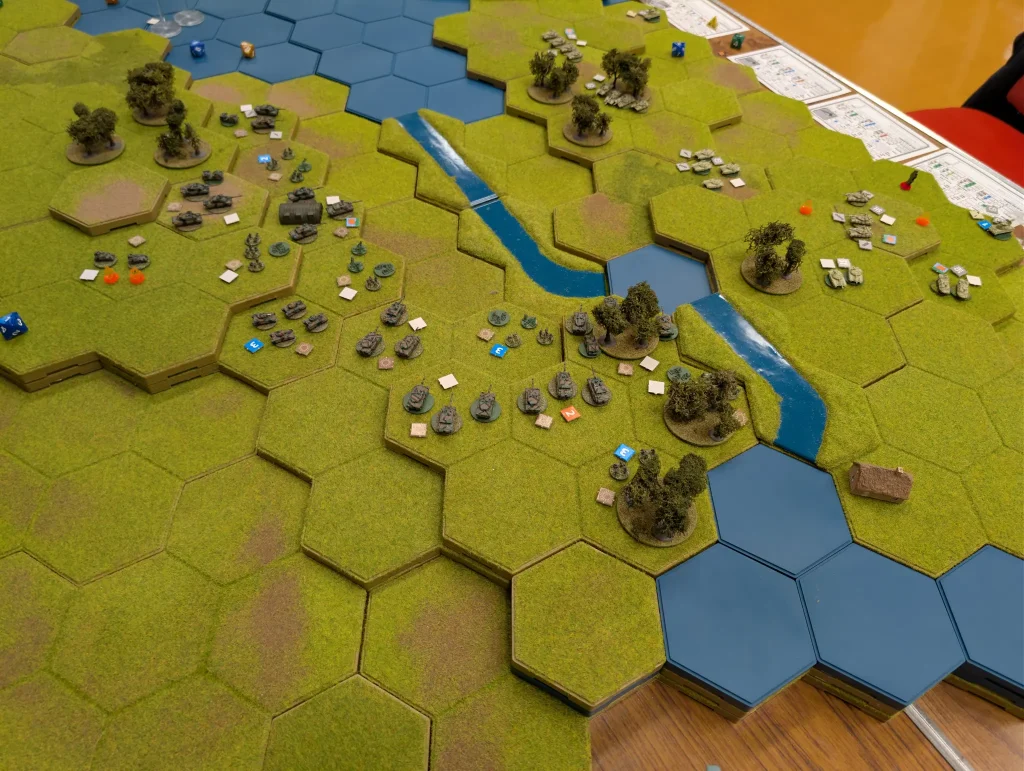
We were again using the Hexon terrain from Kallistra, which allows for some really nice 3D terrain effects. This allows me to build up a river valley with hills either side. The original plan was to be 9 hexes wide, but we ended up going for 12. This gives a better sized game area, but meant I had less hexes to build up the hills (I’d planned for much higher hills up river). Next time I should maybe bring three boxes of terrain rather than two (I have seven boxes total, but some of it is sea and desert).
The idea was for the Russian invaders to try and force their way across the river and to the far side. If they could secure the far river bank, then they’d get a partial victory. If they could get the far side, then they’d win.
As it was, I wasn’t expecting success for the Russians. I haven’t really pointed out all the modifications I’ve made to replicate modern vehicles, but the NATO tanks are probably a bit under costed. The arrangement of the two sides also set things up as an effective killing zone along the valley. The British Challengers and German Leopards would probably be very effective against the lighter and less well armed T-72s, T-80s and T-90s.
The opening move was for the NATO forces to send in a couple of A-10 Thunderbolts to try and strike at the Russian flank. The first flew in, and was targeted by a Russian Tunguska air defence system. I had two of them, one on each flank. They both protected a 36″ radius around them, giving pretty good coverage.
The first A-10 was shot down (first victory to the Russians!). The second followed in close behind, and managed to avoid being shot. It dropped some Dead Fall Ordnance (DFO) over a unit of amphibious BMP-3s and also on a unit of T-72s. It got two effective strikes, completely wiping out the unit of BMP-3s, and three quarters of the T-72s. This meant half of the Russian infantry were now gone.
The A-10s were equipped with 3 loads of DFO, and they’d need to spend two turns rearming.
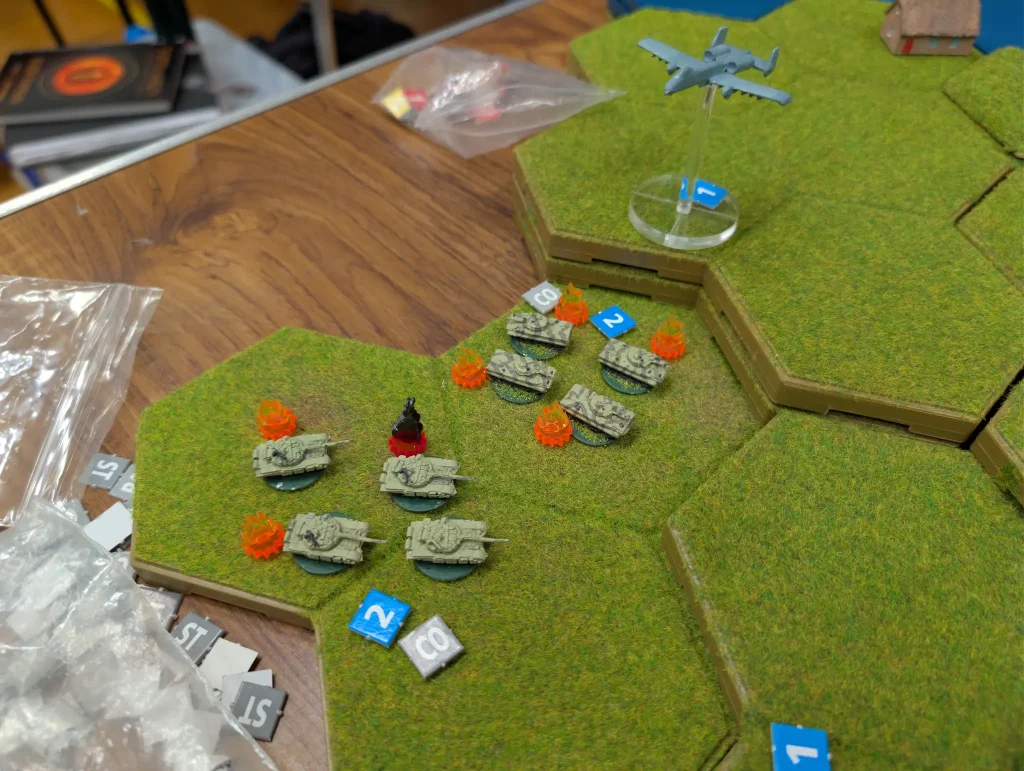
Not a great start for the Russians, but at least an aircraft had been shot down.
Briefly, we forgot Dirtside used alternating activations, and defaulted to I Go You Go. After another NATO unit had acted, we switched to alternating, allowing the Russians a chance to do something.
With the Challengers and Leopards dug in on the far side of the valley, it was going to be very difficult to move across. I had originally planned to move around at the head of the valley, keeping behind the trees, but my main units set up for that had just gone up in fire and smoke.
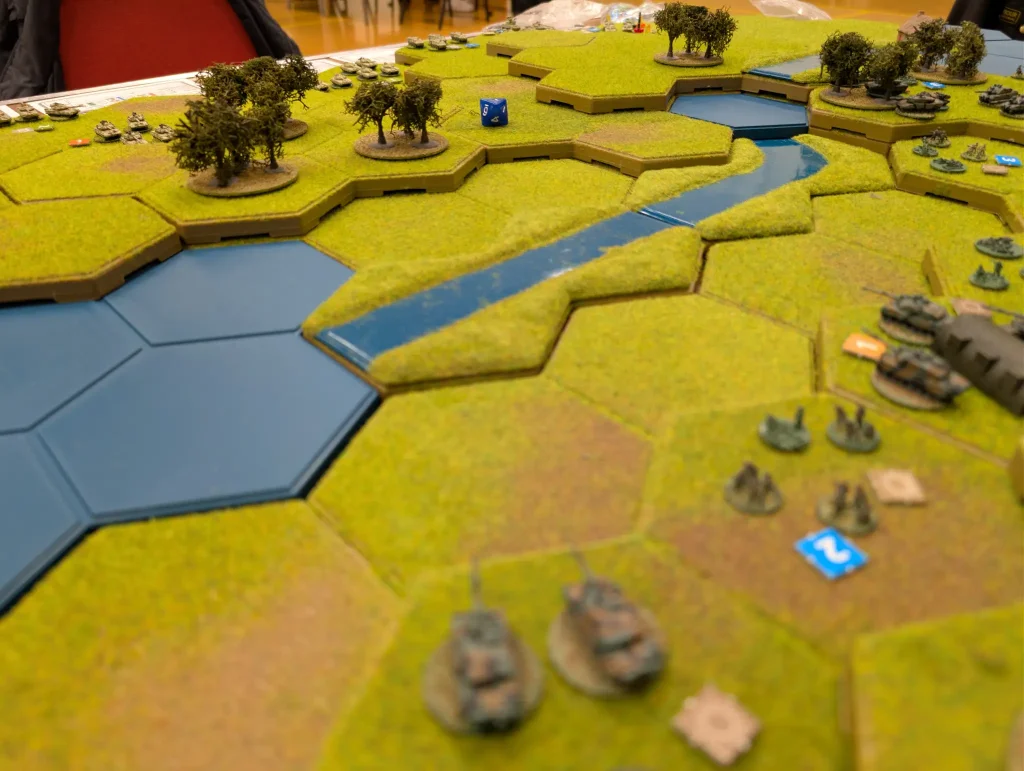
So we started moving out to try and rush down into the valley and across the river. The Challengers were at the limit of gun range for the Russian tanks, but within accurate shooting range for the Challengers. The way direct fire combat works, is that a fire control die is rolled for attack (ranging from D4 up to D12), and that needs to exceed a roll based on the target size (again, D4 for Size 5 vehicles, to D12 for the smallest Size 1 vehicles). Since they were dug in, the NATO tanks also got to roll a D12, and took the highest of that and their Size roll for defence.
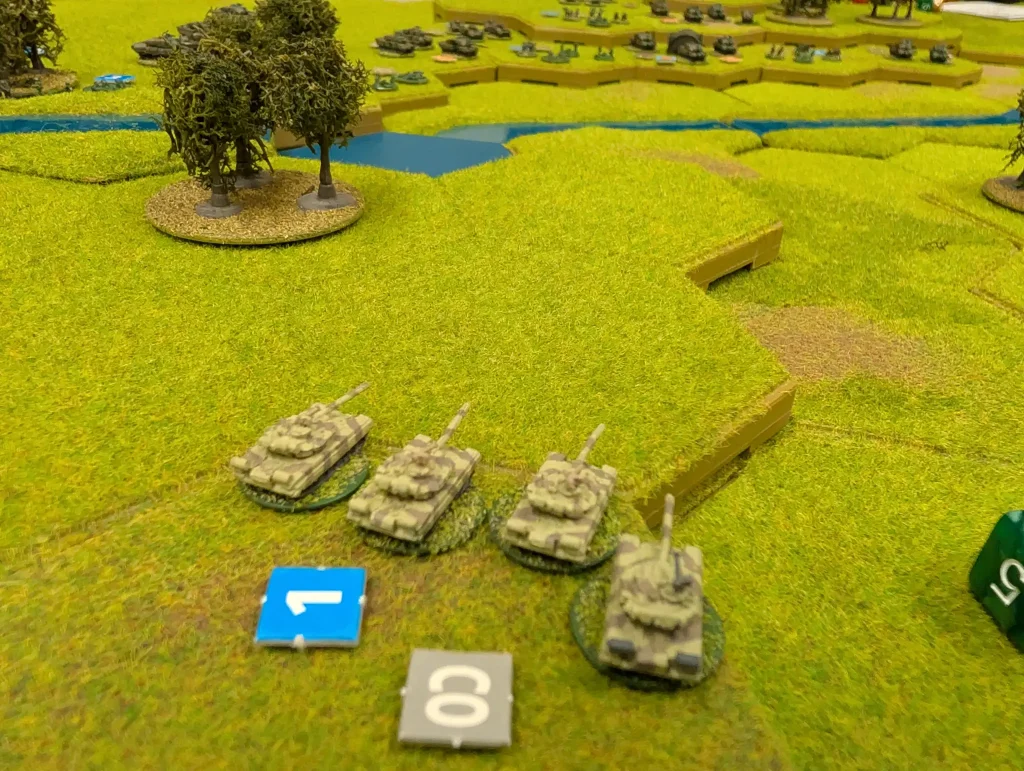
On a hit, we draw chits. The Challengers and Leopards had Size Class 5 weapons, and drew 5 chits. Challengers had greater range and accuracy, then Leopards did more damage. Chits are about 50% Red, 25% Yellow and 25% Green, and have a number 0 to 3. Then there are a number of ‘critical hit’ chits. At close range, Leopards damage on any colour, and Challengers damage on Red or Yellow. They get worse at greater ranges.
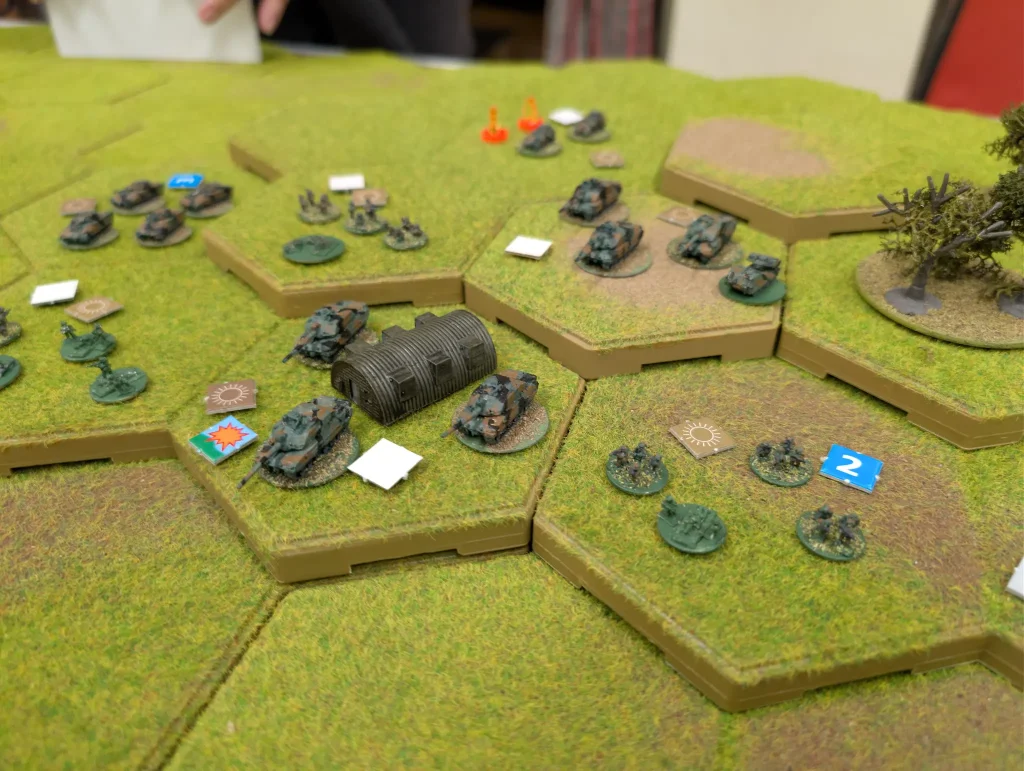
We ended up playing a single turn, but the layout of the terrain and the disparity between the two sides meant that there were a lot of Russian casualties. Basically, the valley was too open a battlefield and it turned into a shooting gallery.
The Russian tanks had the ability to fire GMS/L from their tank guns, which were far more effective than their usual rounds. This took out most of a unit of FV-102 Strikers (GMS Carriers), and did some light damage to some tanks. Given that GMS weapons have unlimited ammo, this is possibly a problem. In fact, the two problems we encountered with GMS were that being in cover or dug-in didn’t seem to make much difference, and that everyone has unlimited ammo. For some vehicles, it may make sense to limited the number of guided missiles they can carry. Vehicles should also get cover bonuses against GMS.
We also need to double check out the rules work for local defence and area defence, and I need to verify exactly what sort of ECM systems modern tanks should have. Further readings suggest that they have active missile defences. These days, they probably have drone defences as well.
Apart from a couple of Predators (which were treated as a unit of VTOLs), we had no drones. We also had no artillery. In a real game, softening up the NATO lines with some artillery fire would have helped.
For drone combat, I have ideas as to how I want to do it. Probably, make it similar to artillery – allow an infantry drone operator unit to make an immediate strike at any target within range, not requiring line of sight. Allowing a single attack on a single element. It would need to be effective enough to be a danger to tanks once it gets past active defences.
I think I need to assume these scenarios are happening in a time when both sides know how to use drones and also defend against them. In reality, we seem to be in a situation where everyone outside of Ukraine is still waking up to their effectiveness. So more active point defence and ECM.
Our next game should also pay more attention to the point costs, to try and balance things out a bit more. The purpose of this game was very much to remind ourselves of the rules, and not care too much about balance. There’s also a chance that I’ve put things too much in favour of the British and German tanks. Modern Russian tanks do have a reputation for blowing up, but I’m not sure how they really compare to their NATO counterparts.
Next time, we probably also want to give infantry a bit more of a chance to do something.
Despite the one sided nature, it was an interesting game, and reminded us of how the basic rules work. I also need to start looking at other 6mm modern rule systems as well. Though we had only a single turn, it didn’t feel like that. With alternating actions, plus overwatch, we were both engaged in the game throughout, and always had something to do.