Into the Breach
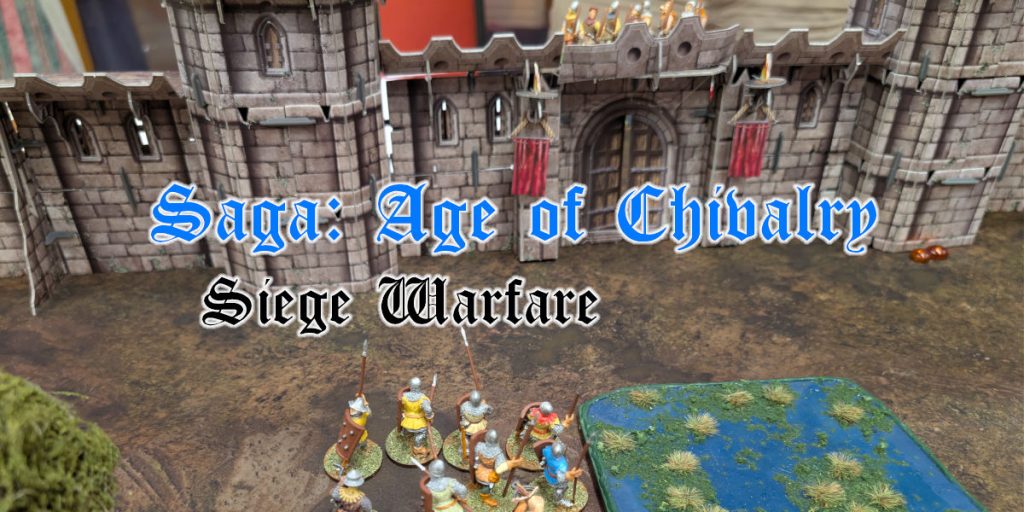
A while back we had a game of Saga using the Intro the Breach rules. They worked, but I felt they could be improved to fit the terrain I was using for the castle better. So I made some modifications, and tried them out with another Age of Chivalry battle between the English and the French.
The English were defending the castle, whilst the French were assaulting it. The French units were dismounted. As before, the castle was stretched along one long edge, and it was the task of the attacker to force their way across the walls and into the castle.
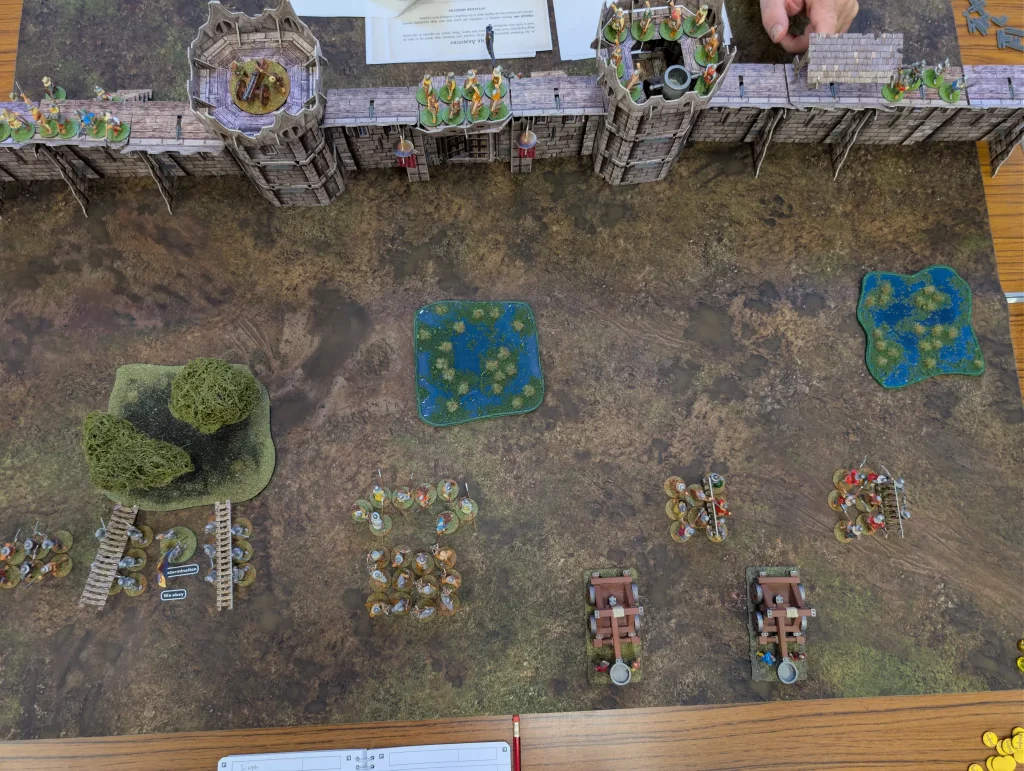
The main change I made to the Into the Breach rules was that the walls count as buildings. This allows the defenders to actually occupy the walls and towers. Fights would be over who occupied the fortifications, not just about crossing them.
The English had 6pts, which included three units of archers, two units of hearthguard and a standard unit of warriors.
The French, being the attacker, had 8pts. They had three points of dismounted knights, as two units of 6 hearthguard. There were a unit of Pavises, with some crossbowmen behind them. Then there were three units of infantry warriors.
We also had siege equipment, and both had 4 points to spend on that. The attacking French took 2 catapults, plus four ladders. The English had a pot of boiling oil, a ballista and some improvised missile weapons.
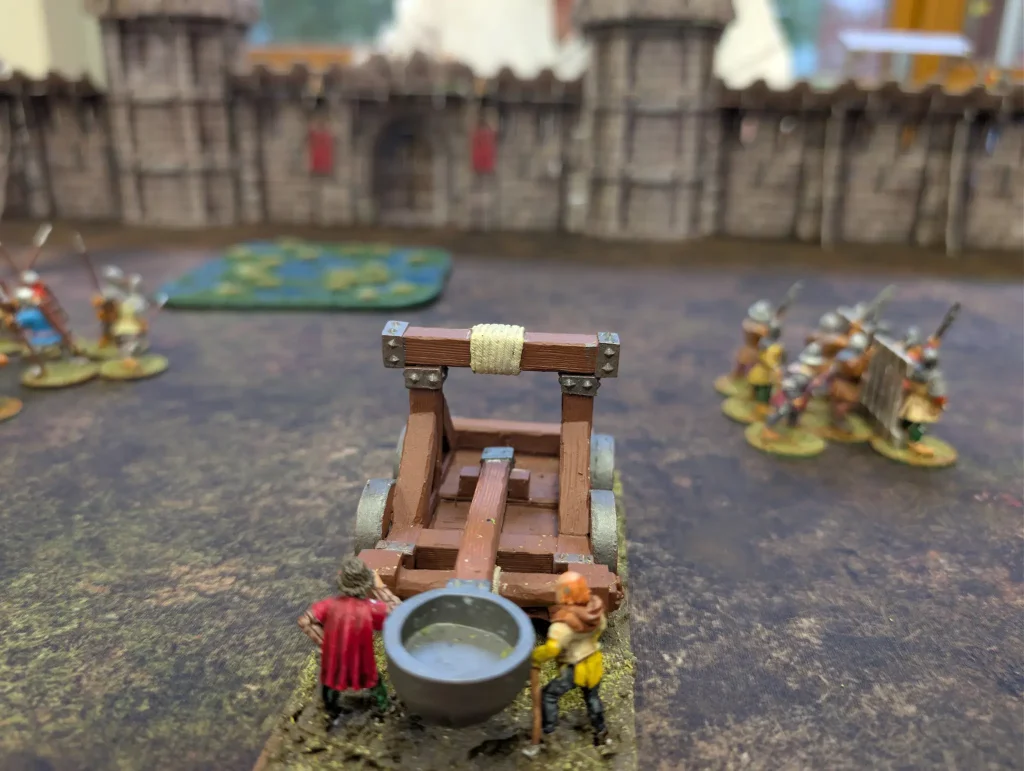
The castle was arranged so that it stretched across the defender’s side of the table. There was a single stand of trees, and two marshes – possibly the remains of a once proud moat.
It was then time for the battle to commence!
Turn 1
The French went first, moving forward as best they could. The two catapults both got a free shooting attacking, aiming for the eastern tower. Both scored a single hit. Seven hits would be needed to bring the tower down. Checking the rules afterwards, it’s actually just five hits for the towers (same as the walls, it is the gatehouse which needs seven), but I think seven works better.
The crossbowmen were hiding behind the Pavises, which were slow moving, so weren’t close enough to shoot.
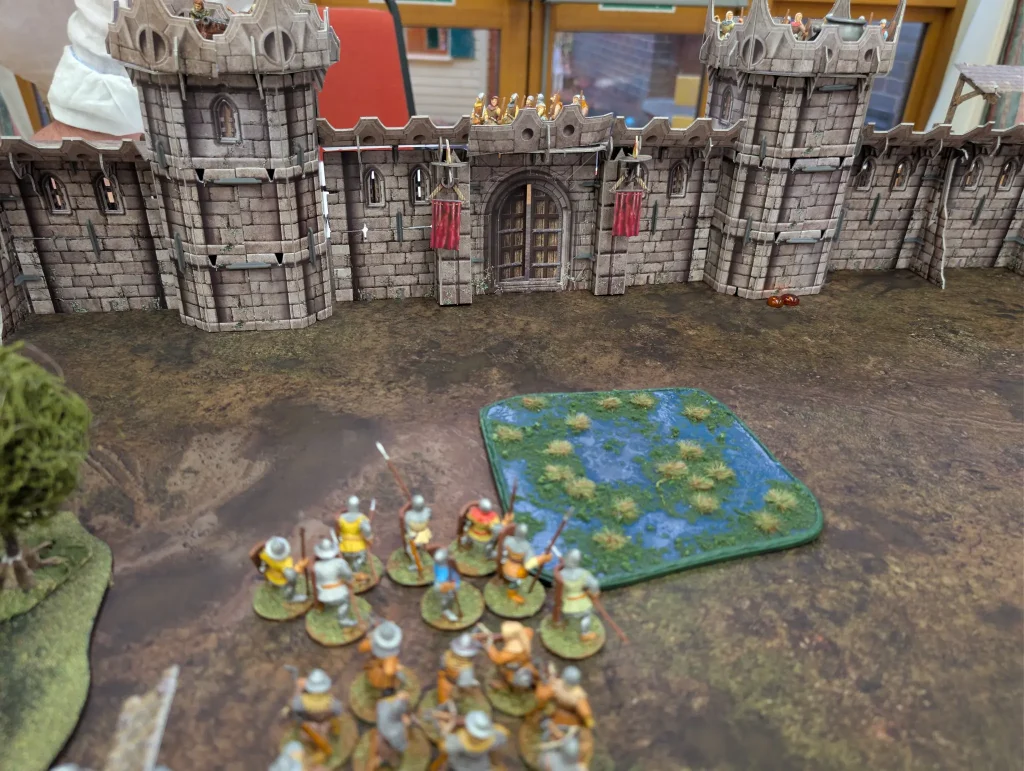
One rule that I added was that when shooting to/from castle walls or towers, it is possible to shoot over other units. I think this makes a lot more sense. However, if the unit being shot over is within short of the target unit, then the target can elect for the first casualty to apply to the other unit. That allows for both friendly fire, and using another unit as cover.
Pavises also grant a +1 defence bonus to a unit directly behind them, allowing them to actually be used in their purported role of defending shooters.
My plan for the French was to get to the walls as quickly as possible. They were expecting to come under some heavy arrow attack by the English, and wanted to keep casualties to a minimum before really being able to get stuck in.
As expected, the English did some shooting. First they used their ballista against one of the French hearthguard units carrying ladders. They got two hits, but the French got two saves.
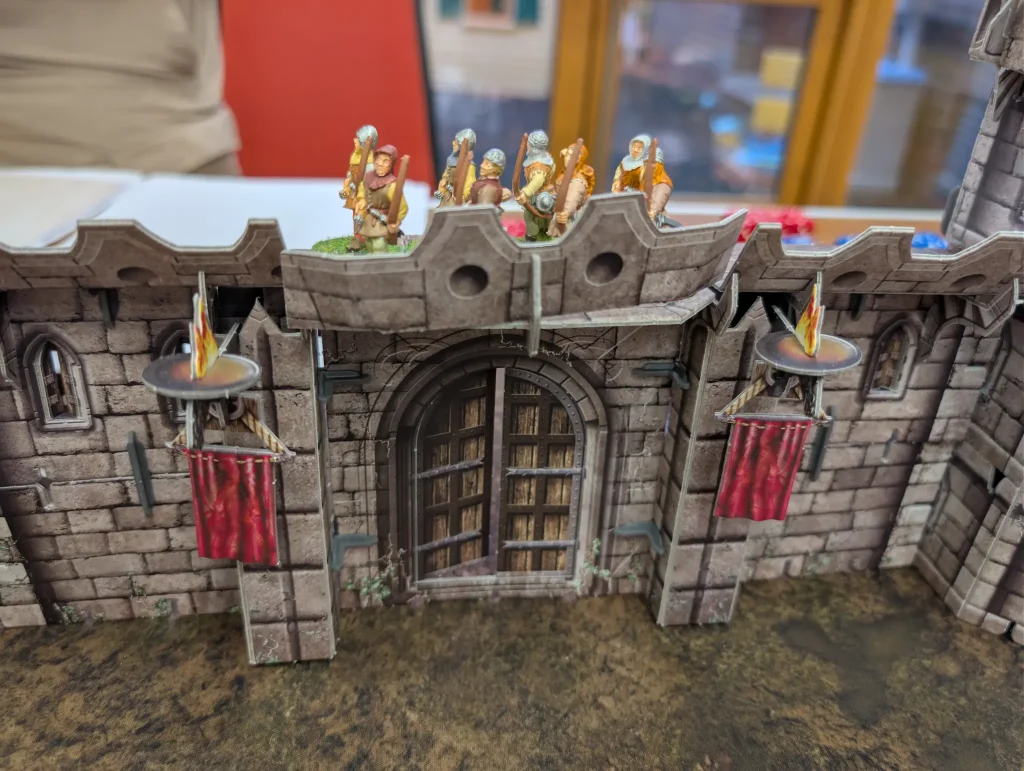
Then it was Wall of Arrows, allow two units to shoot. Archers on the western walls shot at my warriors, getting hits but no kills. The archers on the Gate House shot at the Pavises, getting a single hit but no kills.
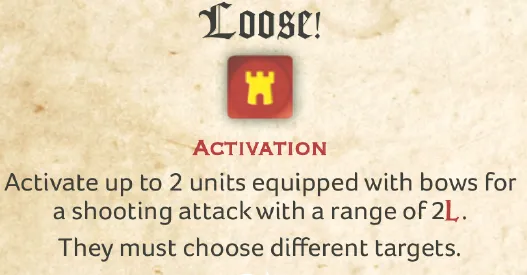
Then they used Loose, which is much improved since the last set of Saga errata changes. On the Eastern wall, the archers got three hits against a group of warriors carrying a ladder, and killed one of them. Then the Gatehouse archers shot again, and got two hits and killed a single Pavises warrior.
Finally, it was another round of Wall of Arrows. They combined it with Hail of Arrows, getting four hits and a single kill against the French hearthguard. A final shot by the Gatehouse archers got three hits and no kills against the Pavises.
I was making some very good defence rolls for the French, so the English shooting hadn’t been as effective as maybe it should have been.
Turn 2
The French did their Orders, then the English played Rain of Arrows to shoot during my turn. I played Tenacity, and used an English fatigue to increase hearthguard armour, but no hits were scored.
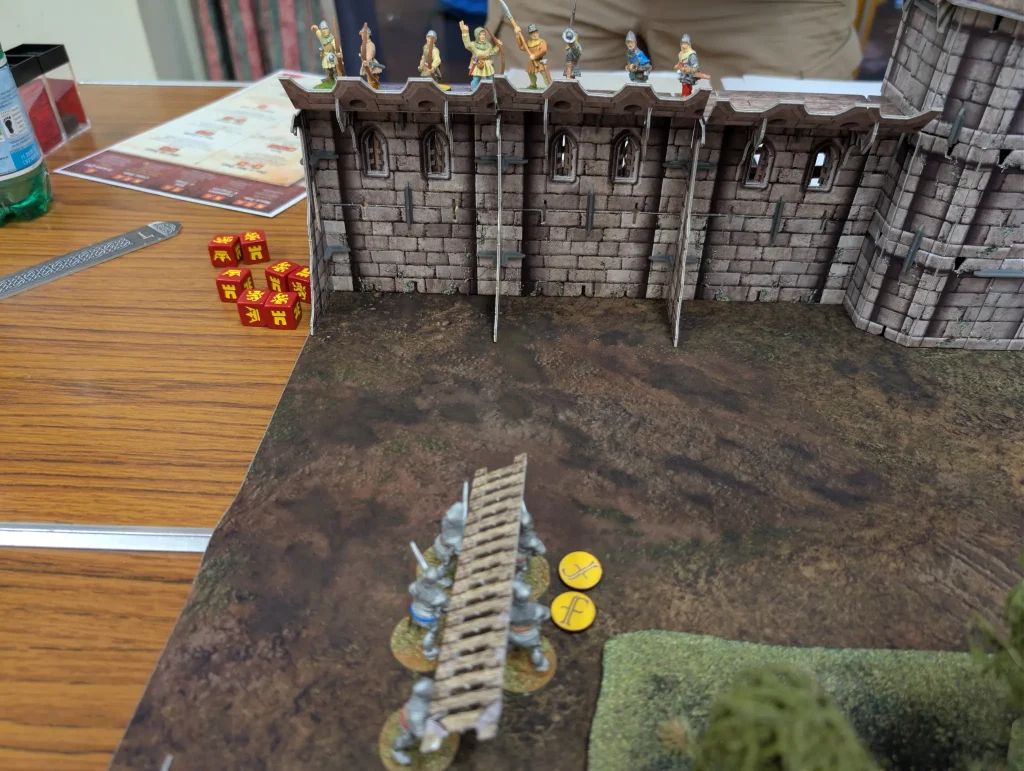
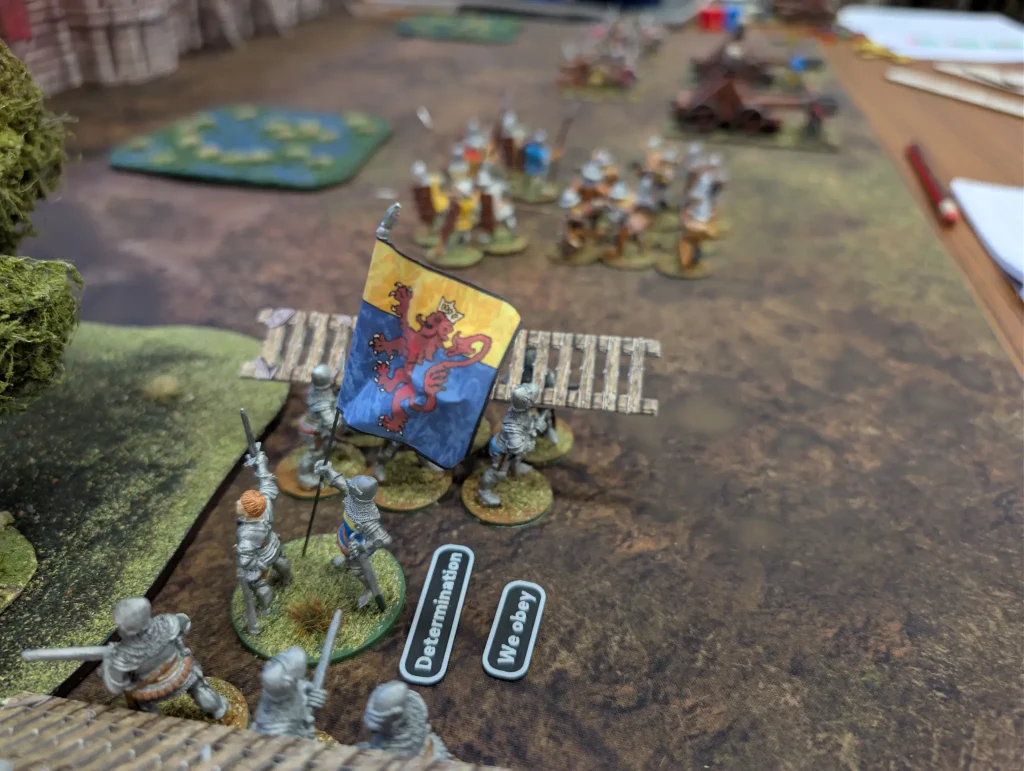
The hearthguard were quite fatigued, so they rested before moving forward again. The French Warlord used his Determination and We Obey to be able to order the warriors to backup the hearthguard, and the turn was finished off with another attack on the eastern tower with the catapults. Only a single hit was scored.
The English used their activation pool to roll a couple of extra lions, allowing them to take Wall of Arrows again. Their ballista got zero hits against my hearthguard, and their archers rested.
Then it was Wall of Arrows, followed by Loose, followed by Wall of Arrows. On the westen flank, one warrior fell. On the eastern flank, three warriors fell. Hail of Arrows was also used against the French hearthguard, and though they took no casualties, they gained another fatigue.
The French were using the English fatigue at this point to raise their own armour. I could have let them just exhaust themselves. Not sure whether that would have been the best approach, but my losses were relatively low by using the fatigue to raise my armour.
Turn 3
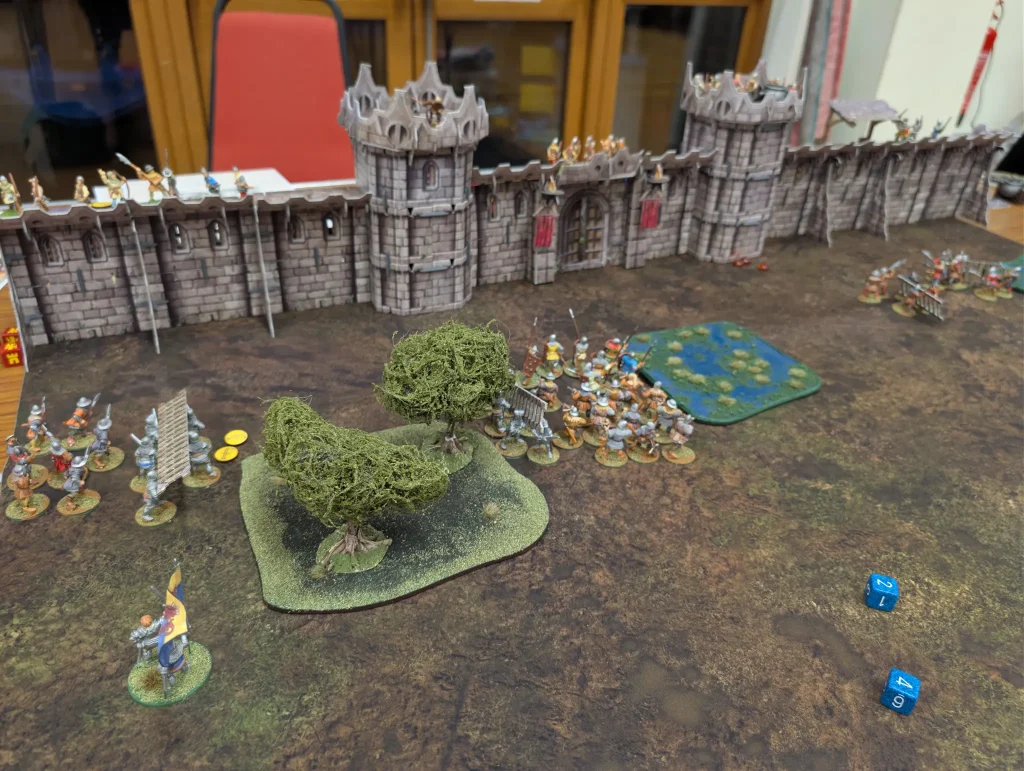
By now the French were getting close to the walls. I could have started a little bit closer at the beginning of the game, and in hindsight I should have. I was slightly more than Medium from the walls for several units, so out of range of charging the walls.
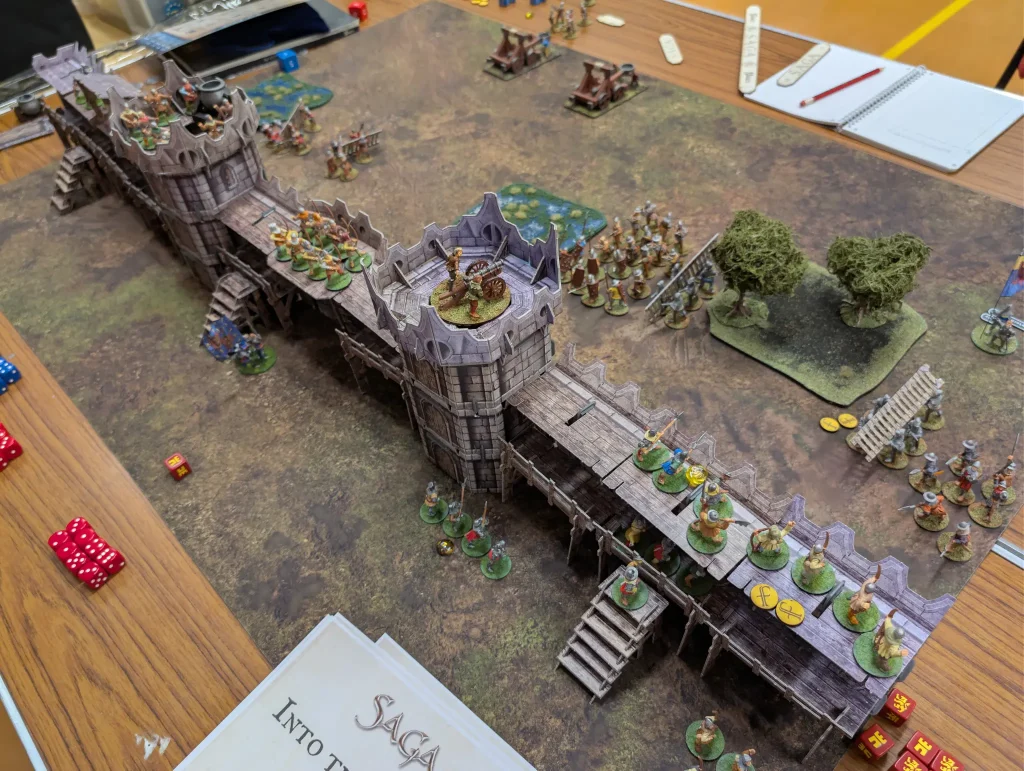
The English used Rain of Arrows to kill one of my warriors, then my catapults opened up on the eastern tower. Both catapults scored two hits, causing the tower to collapse! Six of the archers in the tower were killed in the collapsed, leaving a couple of figures fatigued and choking in the rubble amongst the ruins.
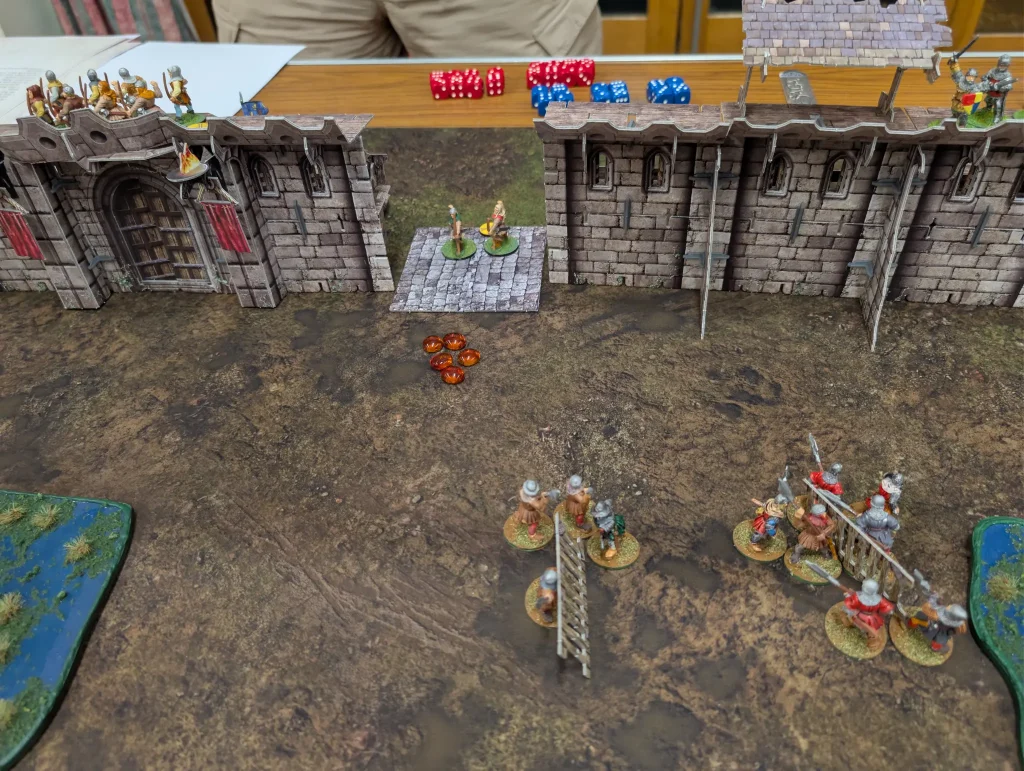
This opened up (literally) a whole new set of options. The French warriors were a bit annoyed that they’d carried their ladders all the way across the battlefield, only to now not need them.
However, this turn I didn’t take advantage of the breach. My units moved forward and into range – my plan was to use Flying Wedge next turn. My crossbowmen did finally get within range, and added Feat of Arms to a shooting attack to fire at the archers above the gatehouse. I got seven hits (including the automatic hit from Feat of Arms). They were in hard cover, but the archers still took five kills.
This turn, God was obviously French.
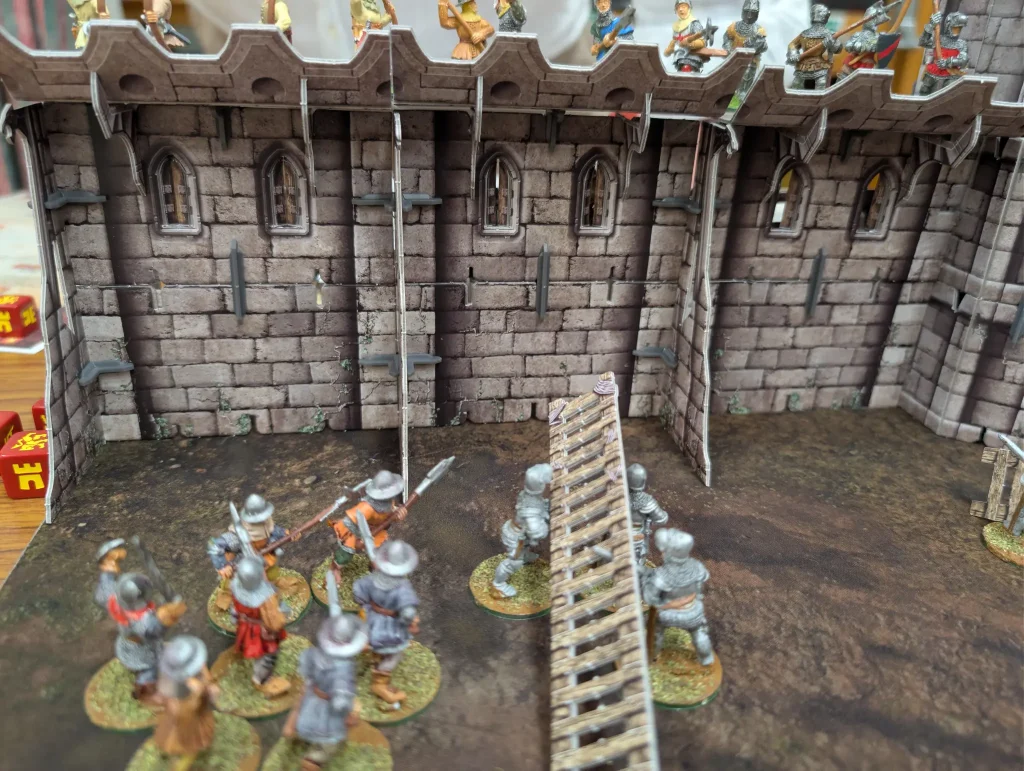
The English now had a problem. They had been planning on moving their archers out of the tower this turn, expecting it to collapse next turn. The heavy casualties also meant they were down two dice and most of two archer units.
Their ballista managed to get two kills on a unit of French hearthguard, and a single Wall of Arrows using archers and improvised missile weapons to kill another French warrior.
English hearthguard came up onto the western wall to defend that, and the ones to the east came off the battlements to defend the breach, along with the English warlord.
Turn 4
The French rest their hearthguard, and then play Flying Wedge, activating three units for charge.
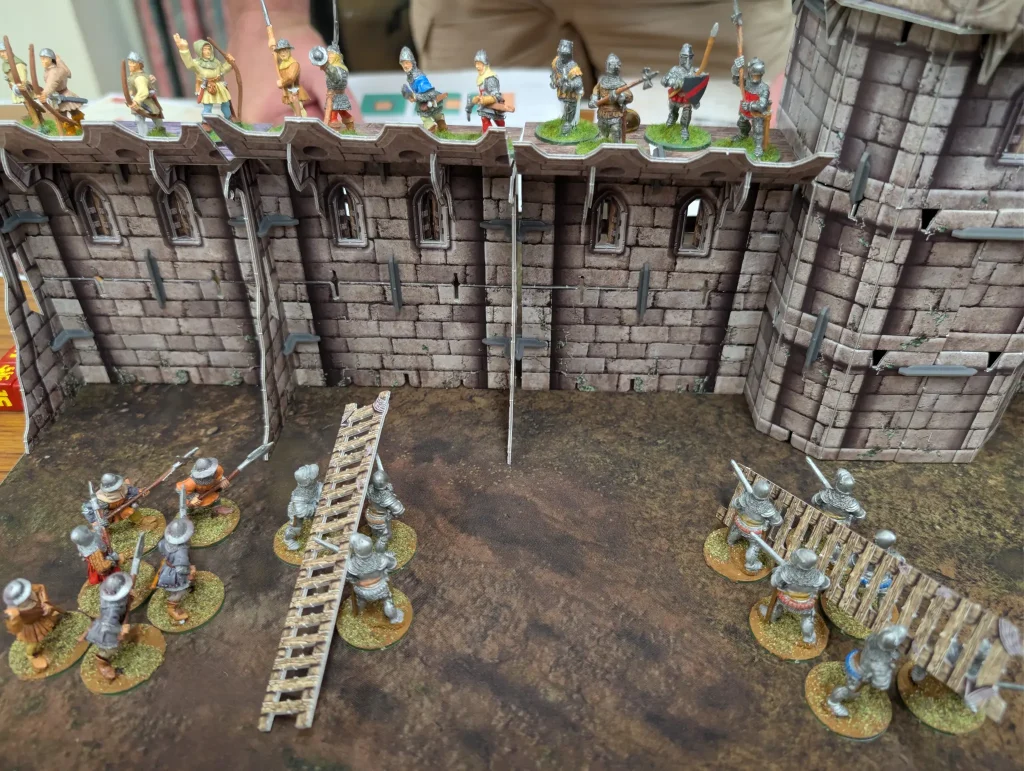
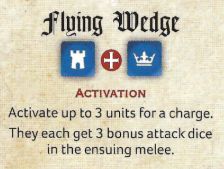
My unit of three remaining hearthguard place their ladder against the wall, and charge up into combat, playing Panoply which allows them to re-roll 1s and 2s. They get a further +3 dice from Flying Wedge, so get 9 attack dice and 4 hits and 4 kills, forcing the unit of warriors off the battlements. The French take 1 casualty.
Then my unit of 6 hearthguard charge up onto the battlements. The use Armed and Armoured to get 4 extra attack dice, but I think I forgot the 3 dice from Flying Wedge. The English hearthguard at the top defend well, and we both get 3 kills, so the French are rebuffed.
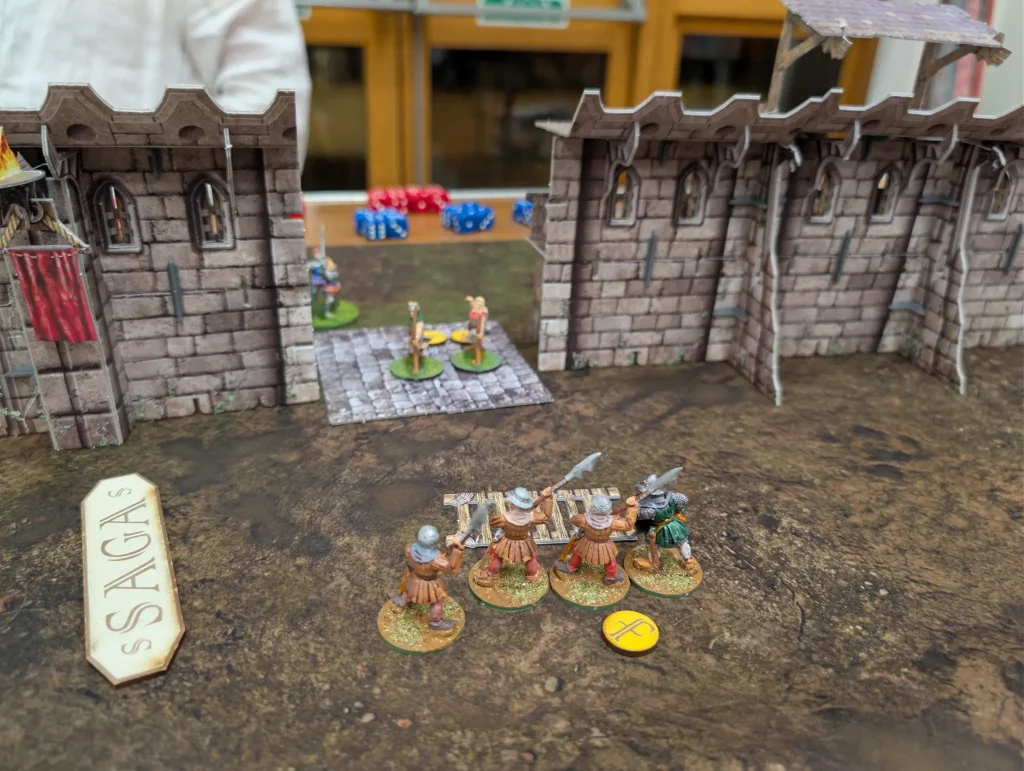
Finally, my warriors at the breach charge against the archers defending it, and zero kills are gained. Once again, I forgot the Flying Wedge bonus, so the French bounce.
To round things off, the crossbowmen fire at the few remaining archers on the gatehouse, but miss. The catapults fire at the gatehouse, getting two hits and causing some fatigue on the archers there.
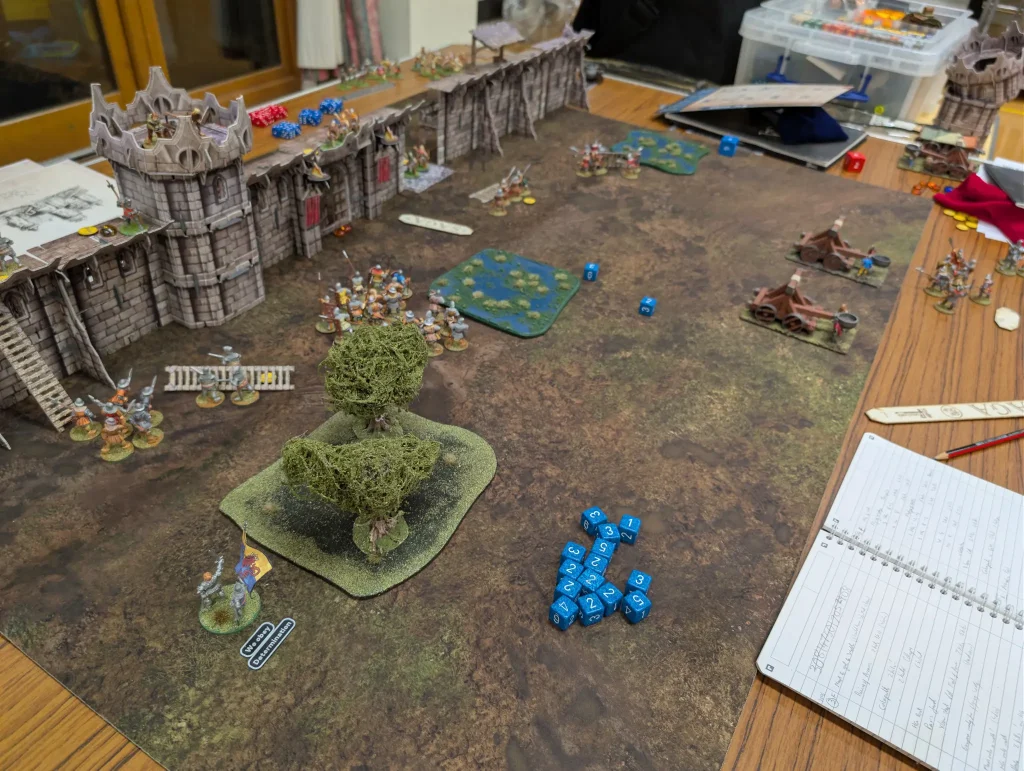
The English now have a lot to defend. They use Wall of Arrows against the warriors at the breach, to no effect. The second volley is aimed at the warriors in the west, and two hits and two kills are gained.
The ballista kills one warrior at the breach, and the rest of the turn is spent reinforcing. The one hearthguard on the battlements is replaced by a fresh unit of warriors.
Turn 5
Though we were aiming for 6 turns, practicality dictates that this is the final turn of the game. The French play Flying Wedge again, and manage to gain control of two sections of the battlements. An attempt against the archers still there is rebuffed though.
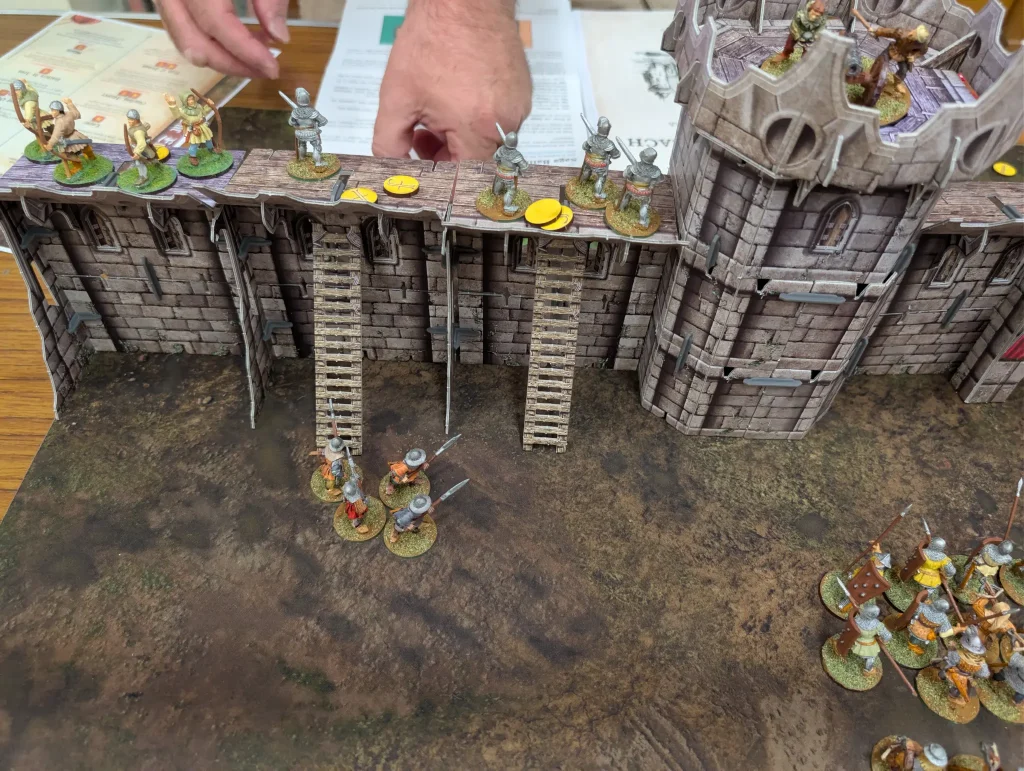
A final attack against the breach pushes back the English defenders, allowing the French to hold the ruins of the tower.
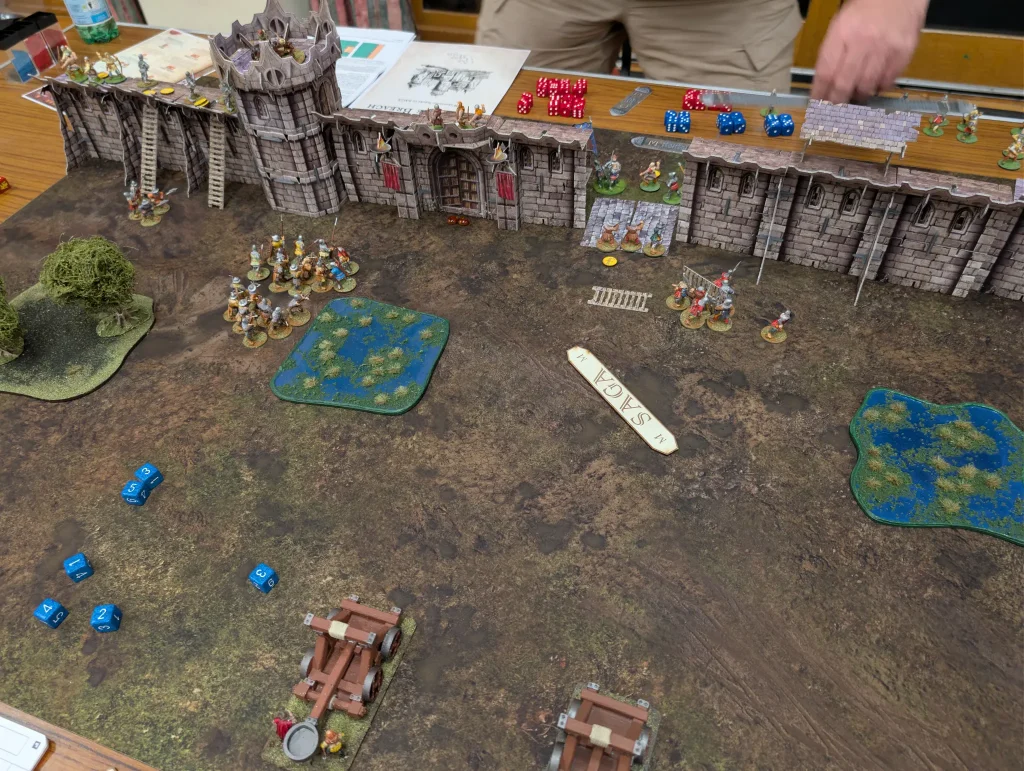
We call it for the evening. It’s looking like a final victory for the French, though there have actually been a lot of French casualties. Most of their knights are dead, and they’ll probably lose more in the taking of the castle.
A lot of French warriors have also been killed, and there are surprisingly few remaining. However, the English have lost whole units, and aren’t really in a position to prevent the French from getting over and through the walls and into the castle proper.
If the English had a keep to fall back to, then maybe things would be different, but the English concede defeat.
It was a good battle, with the French having some lucky rolls at the right times.
A better tactic for the attacker may have been to have taken three catapults and fewer ladders, and just knock down the walls in the East, letting the hearthguard do the work of storming battlements in the West.
My updated rules seemed to mostly work. There were some questions about whether Saga abilities could be used with siege weapon attacks. It was decided no. It would probably make a big difference, especially the chance to give shooting bonuses to catapults and ballista.
There weren’t too many tactical choices for the English – the first half of the game was the French marching across the table, and the English shooting at them. At first, the scenario seemed quite generous allowing the French to start L from their edge (which was why I started a bit further back), but that actually works. It allows the main fighting to happen sooner.
There are a few things to clarify, but not too much. It was a close enough fight to be balanced enough, and both of us are willing to give it a try again, with the attacker/defender reversed.

It was a good game!
Yes indeed, game looked great, developing siege rules, is really interesting.